Ghana’s parliament debates new tax policy amid revenue push


Follow Nukunya
Get the latest breaking news and updates from Nukunya.
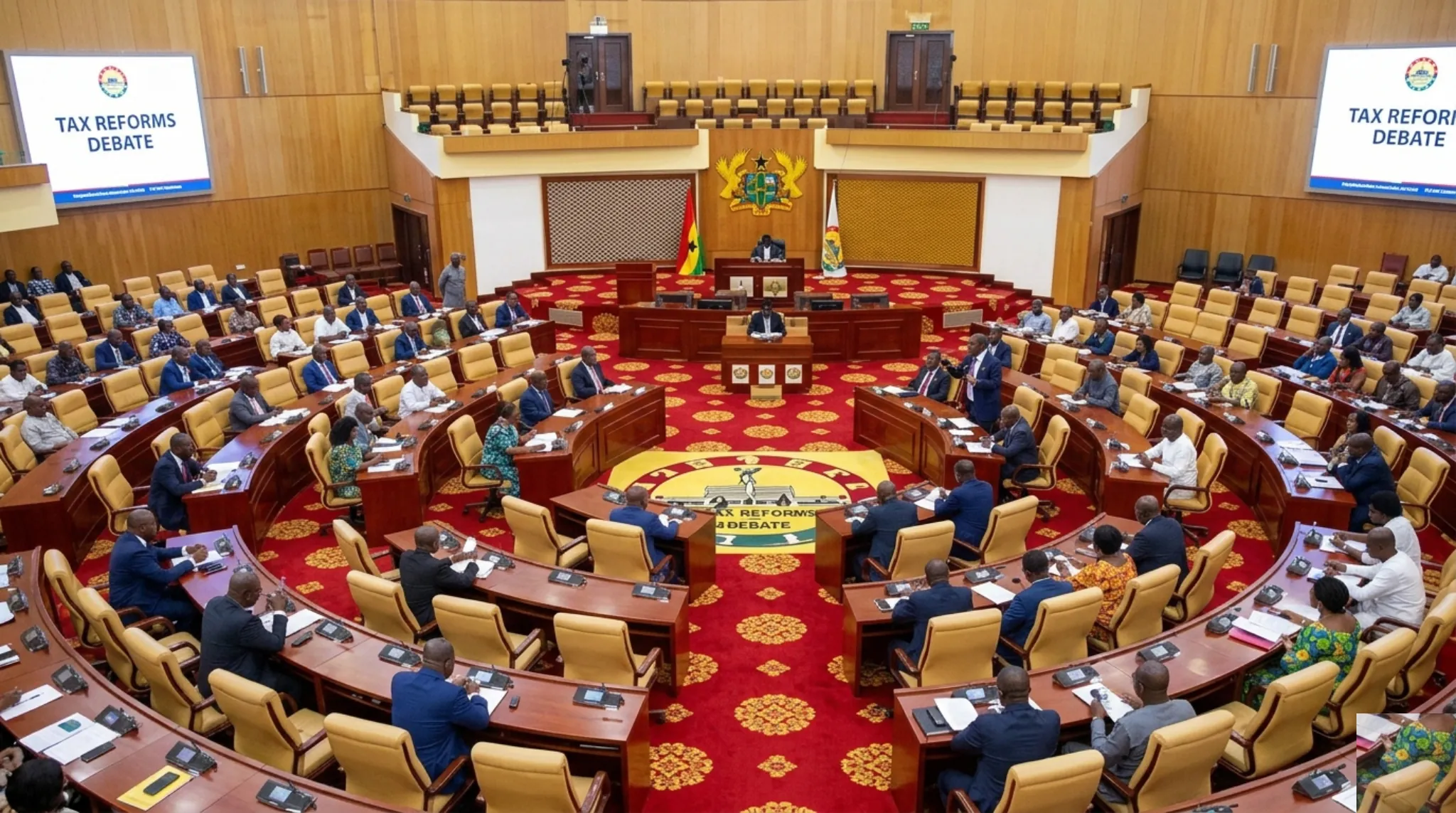
Ghana’s parliament debates a new tax policy aimed at boosting revenue, as officials argue reforms are needed to stabilise public finances under IMF commitments.
ACCRA, Ghana — 5 May 2026
Ghana’s tax policy debate intensified in parliament on Monday as lawmakers considered new fiscal measures designed to increase government revenue and support ongoing economic reforms. The proposed policy package, presented by the Finance Ministry, includes adjustments to value-added tax (VAT), expansion of the tax base, and stricter enforcement mechanisms aimed at reducing revenue leakages. Officials said the measures form part of Ghana’s commitments under its International Monetary Fund programme, which requires stronger domestic revenue mobilisation to address fiscal deficits.
Ghana’s tax policy debate centres on revenue and compliance
Finance Minister Dr Mohammed Amin Adam told parliament that Ghana’s tax-to-GDP ratio remains below regional averages, limiting the government’s ability to fund public services and infrastructure. “Our revenue performance must improve if we are to sustain economic recovery,” he said during the session. “The proposed reforms are targeted at efficiency, fairness, and compliance.” According to the Ministry of Finance, Ghana’s tax-to-GDP ratio stands at around 13%, compared with a sub-Saharan African average closer to 16–18%. The government argues that broadening the tax net, particularly within the informal sector, will reduce reliance on borrowing and support long-term fiscal stability.
Opposition raises concerns over cost of living
Opposition lawmakers criticised the proposals, warning that additional taxes could worsen the cost-of-living pressures already facing households. Minority Leader Dr Cassiel Ato Forson said the timing of the reforms was problematic, given ongoing economic hardship. “Ghanaians are already struggling with high prices,” he said. “Any new tax burden must be carefully assessed to avoid deepening the crisis.”
He called for greater emphasis on expenditure control and tackling inefficiencies in public spending rather than introducing new tax measures. Civil society groups have also urged the government to ensure transparency and fairness in the implementation of any new tax policies.
Human impact: small businesses under pressure
For small business owners, the outcome of the tax policy debate in Ghana could have immediate financial implications. At Kaneshie Market in Accra, trader Josephine Owusu said even minor tax increases can affect pricing and customer demand. “When taxes go up, we have to increase prices,” she said. “Customers complain, and sales go down.” Similarly, a local manufacturing entrepreneur, Kofi Mensah, said compliance costs are already high. “We are willing to pay taxes, but the system must be simple and fair,” he said. “Too many changes create uncertainty.” Business associations have called for consultations to ensure that reforms do not disproportionately affect small and medium-sized enterprises.
IMF programme and fiscal discipline
Ghana’s fiscal reforms are closely tied to its $3bn IMF programme, which emphasises revenue mobilisation, debt restructuring, and expenditure control. The IMF has repeatedly emphasised the necessity for Ghana to increase domestic revenue to create fiscal space for social spending and infrastructure investment. According to government officials, the proposed tax policy not only aligns with these objectives but also aims to improve compliance through digital tax systems and data integration. However, analysts note that implementation remains a key challenge, particularly in expanding tax collection within the informal economy.
What this means
The Ghana tax policy debate reflects a broader tension between fiscal consolidation and economic relief for citizens. Historical data from the Ministry of Finance show that previous tax reforms have had mixed outcomes, with gains in revenue often offset by compliance challenges and public resistance. Compared with peer economies such as Kenya and Rwanda, Ghana’s tax collection efficiency remains lower, highlighting structural gaps in administration and enforcement.
The World Bank has emphasised that effective tax systems require not only policy changes but also institutional capacity, including digital infrastructure and public trust. In practical terms, the proposed reforms could increase government revenue in the short term, but their success will depend on how they are implemented and perceived by taxpayers. If poorly managed, additional taxes could reduce consumption and slow economic growth. If effectively implemented, they could strengthen public finances and reduce reliance on external borrowing.
The gap between policy intentions and real-world impact remains critical. Households and businesses will assess reforms based on their direct financial effects, rather than macroeconomic indicators. The coming weeks of parliamentary debate and stakeholder engagement will determine whether the proposed measures are revised, delayed, or passed in their current form.
Sources: Ministry of Finance Ghana; Parliament of Ghana; International Monetary Fund; World Bank.
Additional reporting and analysis by Nukunya News Desk
Related posts:
 Ghana’s inflation slows for third consecutive month as food prices ease
  Ghana Rejects $109m US Health Deal Over Data-Sharing Concerns
  Ayawaso East desks donation: MP Baba Jamal gives 1,000 desks to schools
  Ghana Welcomes First Evacuees From South Africa Amid Xenophobia Fears
  Ghana Allocates GH¢442 Million for Flood Recovery and Coastal Protection