
Ghana’s digital ID expansion accelerates as government pushes inclusion

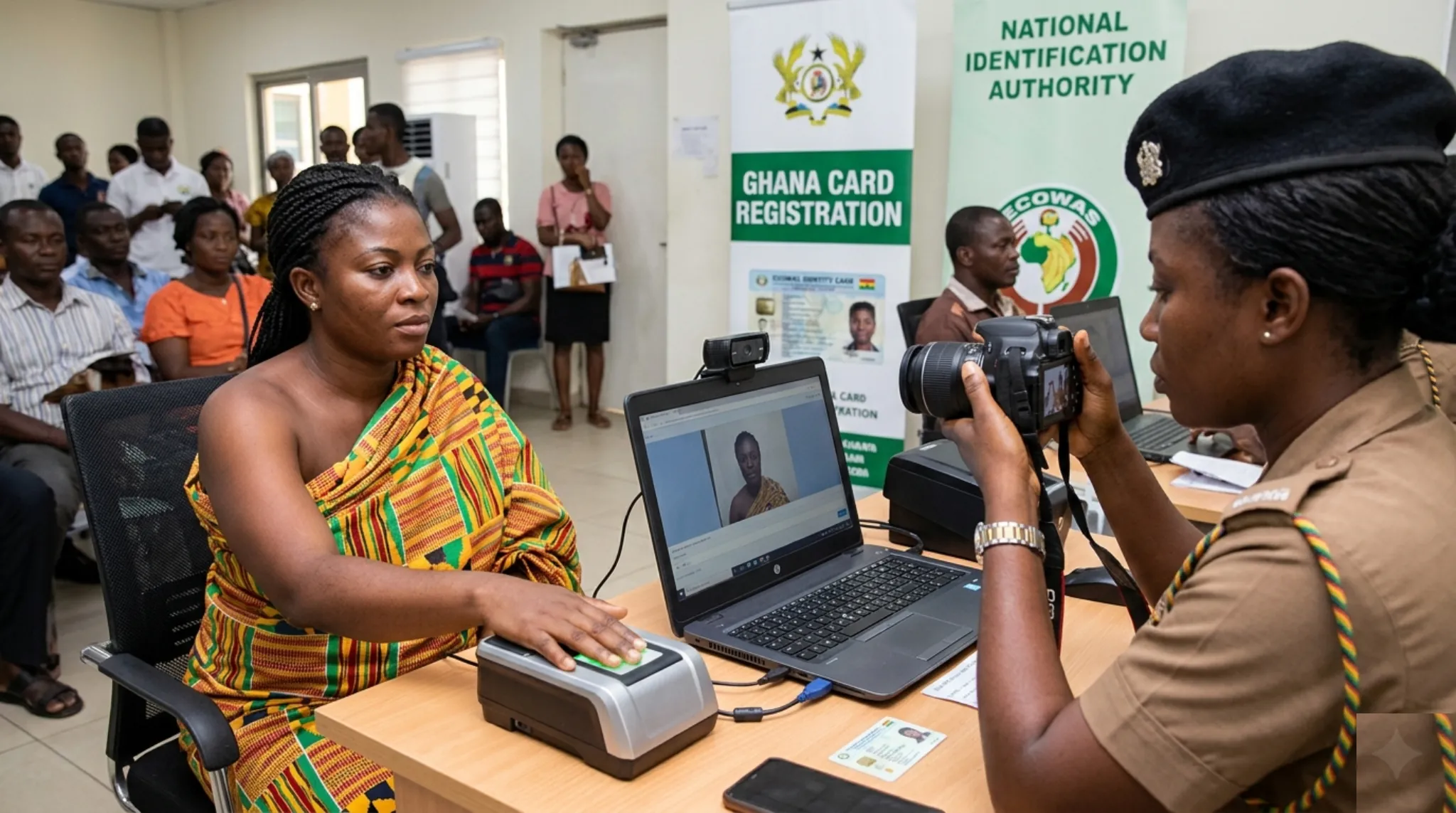

Ghana’s digital ID expansion gains pace as authorities aim to boost financial inclusion and public service access, raising both opportunities and data protection concerns.
ACCRA, Ghana — 5 May 2026
Ghana’s digital ID expansion is accelerating as the government intensifies efforts to register more citizens under the Ghana Card system, aiming to improve access to financial services and public administration. The National Identification Authority (NIA) said new enrolment centres and mobile registration units are being deployed nationwide to increase coverage, particularly in rural and underserved communities. Officials say the expansion is central to Ghana’s broader digital transformation strategy and to efforts to formalise the economy.
Ghana’s digital ID expansion targets financial inclusion
The Ghana Card has become a critical requirement for accessing banking services, mobile money verification, and government programmes. According to the National Identification Authority, over 18 million Ghanaians have been registered so far, but millions remain outside the system, particularly in remote areas. “The objective is to ensure every eligible Ghanaian has a secure, verifiable identity,” an NIA spokesperson said. “This is essential for financial inclusion and efficient service delivery.”
The Bank of Ghana has also integrated the Ghana Card into the financial system, making it a primary form of identification for account opening and transaction verification. Digital ID systems are increasingly considered key infrastructure for modern economies, enabling governments to track service delivery and reduce fraud.
Benefits and concerns over data protection
While the Ghana digital ID expansion promises efficiency, it has also raised concerns among civil society organisations regarding data protection and privacy. Policy analyst Dr Linda Ofori said that we need robust safeguards to ensure that no one misuses personal data. “A national ID system must be backed by strong legal and technical protections,” she said. “Public trust depends on how data is managed.” Ghana’s Data Protection Commission has emphasised compliance with the Data Protection Act 2012, which governs how personal data is collected, stored, and used. Authorities maintain that the system includes biometric safeguards and encryption to protect sensitive information.
Human impact: access to services improves
For many citizens, the expansion of the Ghana Card is already changing access to services. In the Northern Region, farmer Abdul Rahman said obtaining a Ghana Card allowed him to open his first bank account. “Before, I could not access loans or save properly,” he said. “Now I can use the bank and mobile money.”
Similarly, a university student in Kumasi, Efua Boateng, said the card has simplified administrative processes. “It is easier to register for school and access services,” she said. “Everything is linked to one ID.” However, some residents in remote communities report challenges with registration access and delays in card issuance.
Opposing view: risks of exclusion and system gaps
Critics argue that the Ghana digital ID expansion could unintentionally exclude vulnerable groups if the government does not address implementation challenges. Dr Yaw Mensah, a governance researcher, said barriers such as documentation requirements and limited infrastructure could leave some citizens behind.
“If access is uneven, digital ID systems can deepen inequality rather than reduce it,” he said. He also warned that reliance on a single identification system could create risks if technical failures occur. “There must be contingency measures to ensure people are not locked out of essential services,” he added.
Government strategy and digital transformation
The government has positioned the Ghana Card as a cornerstone of its digital economy agenda, linking it to tax identification numbers, health insurance, and voter registration systems. Officials say integration across platforms will improve efficiency, reduce duplication, and enhance transparency in public administration. The World Bank has supported digital ID initiatives globally, noting their potential to boost economic participation and reduce poverty when implemented effectively. In Ghana, the challenge lies in balancing rapid expansion with inclusivity and data protection.
What this means
The Ghana digital ID expansion reflects a global trend towards digital identity systems as governments seek to modernise service delivery. According to the World Bank’s Identification for Development (ID4D) initiative, well over one billion people worldwide lack official identification, limiting access to financial and social services.
Ghana’s progress places it ahead of several regional peers, but gaps remain in coverage and infrastructure, particularly in rural areas. Compared with countries such as India, which has implemented large-scale digital ID through Aadhaar, Ghana’s system is still developing but shows similar ambitions.
The practical impact for citizens is significant. A reliable digital ID can enable access to banking, healthcare, education, and social protection programmes. However, risks remain around data privacy, system reliability, and exclusion of marginalised groups. Policy success will depend on maintaining public trust, strengthening legal safeguards, and ensuring equitable access across all regions. The balance between efficiency and rights protection will define the long-term effectiveness of the system.
Sources: National Identification Authority; Bank of Ghana; Data Protection Commission; World Bank.
Additional reporting and analysis by Nukunya News Desk
Related posts:
 Ghana’s inflation slows for third consecutive month as food prices ease
  Ghana Rejects $109m US Health Deal Over Data-Sharing Concerns
  Ghana’s parliament debates new tax policy amid revenue push
  IMF PCI to Strengthen Bank of Ghana’s Balance Sheet
  Ghana Nears First Non-Interest Banking Licence as BoG Warns on Fintech Trust