
Community Banking Assets Hit GHS26bn as Eight-Million Customers Drive Growth in Ghana



Ghana’s community banking sector has grown into a GHS26 billion industry serving about eight million customers, as the Bank of Ghana accelerates reforms aimed at strengthening governance, expanding financial inclusion and modernising community-based banking.
ACCRA, Ghana – Ghana’s community banking sector has reached approximately GHS26 billion in total assets while serving around eight million customers, underscoring the growing importance of community lenders to financial inclusion as the Bank of Ghana pushes ahead with sweeping reforms across the country’s banking sector.
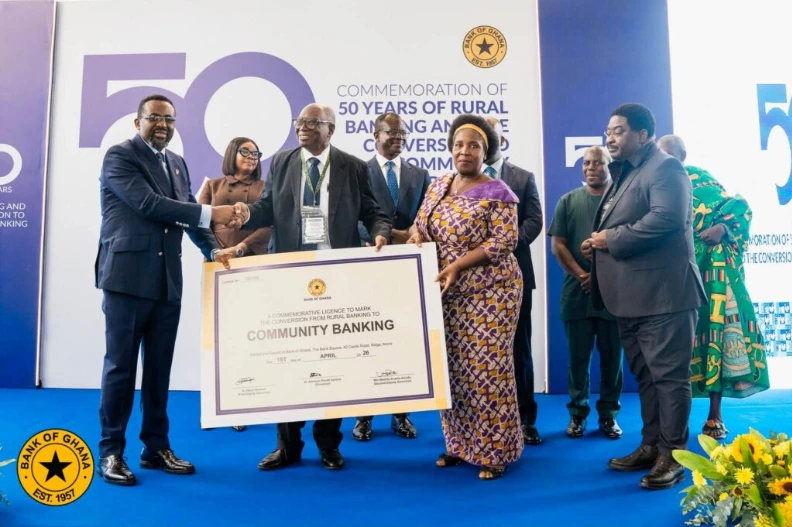
The figures were announced by Bank of Ghana Governor Dr Johnson Pandit Asiama during celebrations marking the 50th anniversary of rural banking. The event highlighted five decades of community-based banking and the sector’s ongoing transition from rural banks to community banks under a revised regulatory framework.
The reforms form part of the Bank of Ghana’s broader effort to modernise Ghana’s microfinance and community banking landscape following years of regulatory restructuring aimed at strengthening governance, protecting depositors and improving access to formal financial services.

From one rural bank to a nationwide financial network
Community banking in Ghana began in 1976 with the establishment of the country’s first rural bank at Nyakrom in the Central Region. Over the past five decades, the model has expanded into one of Ghana’s largest locally owned financial networks.
“What began with one bank at Nyakrom is today 147 licensed institutions, about 1,000 branches, more than eight million customers and an asset base of approximately GHS26 billion,” Dr Asiama said.
Collectively, these institutions now represent one of Ghana’s largest community-based financial systems, providing banking services in districts where access to commercial banking has traditionally been limited.
Why community banks matter
Community banks play a central role in Ghana’s financial inclusion agenda by extending formal banking services to households, farmers, traders and micro, small and medium-sized enterprises (MSMEs). For many rural communities, they remain the primary source of savings accounts, agricultural finance, small business loans and payment services.
Their continued expansion has significant implications for local economic development, entrepreneurship, employment and poverty reduction. As Ghana seeks to deepen financial inclusion, policymakers increasingly view community banks as important partners in mobilising domestic savings and supporting productive sectors of the economy.
Governance reforms accompany expansion.
While praising the sector’s growth, Dr Asiama cautioned that stronger governance would be essential if community banks are to sustain public confidence and continue expanding responsibly.
“The idea was right. The framework around it must now be strong enough to deserve it,” he said.
He said the Bank of Ghana’s reforms are designed to strengthen corporate governance, improve board oversight, reinforce prudent lending practices and enhance risk management across the sector. The governor stressed that community ownership should never be interpreted as reduced regulatory oversight. Instead, he said stronger governance standards would underpin the next phase of growth.
Digital transformation becomes the next frontier
Beyond traditional banking, Dr Asiama said community banks must embrace digital transformation to remain competitive. He urged institutions to expand mobile banking, agency banking, interoperable payment services and other digital financial solutions that improve customer access while reducing operational costs. Digital innovation, he said, would allow community banks to reach underserved populations more efficiently and support Ghana’s broader transition towards a digitally inclusive economy.
Urban community banking framework
One of the most significant reforms now underway is the transition from rural banks to community banks, scheduled for completion by 31 December 2026.
Unlike traditional rural banks, the revised framework permits licensed community banks to operate within designated urban communities while retaining their community-focused ownership structure and development mandate. The Bank of Ghana believes the new model will improve operational flexibility while preserving the institutions’ local character and developmental purpose.
Challenges remain despite rapid growth.
Although the sector has expanded significantly, community banks continue to face several structural challenges. These include strengthening governance standards, improving loan recovery, managing cybersecurity risks, maintaining adequate capital buffers and adapting to rapidly changing customer expectations. Industry observers say continued regulatory oversight and investment in technology will be critical to ensuring long-term sustainability.
Access to justice is also highlighted.
Chief Justice Paul Baffoe-Bonnie, whose remarks were delivered on his behalf, said the philosophy underpinning community banking offered lessons for improving public service delivery more broadly. He noted that bringing essential services closer to communities had transformed access to banking over the past five decades and suggested similar approaches could strengthen access to justice across the country.
What it means for Ghana
The continued expansion of community banking is expected to strengthen Ghana’s financial ecosystem by increasing access to affordable credit, encouraging local investment and supporting small businesses that generate employment.
The reforms also complement Ghana’s wider financial inclusion strategy by expanding regulated banking services beyond major urban centres while improving governance across the sector. With assets now exceeding GHS26 billion and customer numbers surpassing eight million, community banks are expected to play an increasingly important role in supporting Ghana’s economic development while helping to build a more inclusive and resilient financial system.
What Are Community Banks?
Community banks are locally owned, regulated financial institutions that provide savings, loans and payment services, particularly to households, farmers and small businesses.
Under Ghana’s revised regulatory framework, rural banks are transitioning into community banks with broader operational mandates while remaining subject to Bank of Ghana supervision.
What Community Banks Are Expected to Do
Savings
Provide accessible deposit services for individuals, households, associations and local businesses.
Credit
Support farmers, traders, entrepreneurs and small businesses with appropriate lending products.
Payments
Facilitate transfers, bill payments, salary services and other routine financial transactions.
Digital Banking
Expand mobile, electronic and interoperable services for customers beyond traditional branch networks.
Ghana’s Community Banking Sector at a Glance
- Sector assets
- GH₵26bn Held across the community banking sector
- Customers
- 8m People using community banking services
- Licensed banks
- 147 Community banks operating nationwide
- Branch network
- 1,000 Approximately, across Ghana
From Rural Banks to Community Banks
The reform is intended to move institutions beyond a narrow rural-banking identity while retaining their community orientation and local ownership.
- 01 Broader operating mandate
Community banks may serve a wider range of customers and local economic activities.
- 02 Stronger governance
Boards, management systems and risk controls are expected to meet strengthened regulatory standards.
- 03 Greater digital capability
Banks will need technology that supports secure, efficient and accessible digital services.
- 04 Continued supervision
Institutions remain regulated and supervised by the Bank of Ghana.
Why the Reform Matters
Financial Inclusion
Community banks can provide formal financial services in locations where large commercial banks have limited branch coverage.
Local Enterprise
Better access to credit can support farmers, traders, cooperatives and small businesses that drive local economies.
Community Ownership
Local ownership may strengthen customer relationships and ensure that services reflect community economic needs.
Stronger Institutions
Improved governance, capital discipline and risk management can help protect depositors and support sustainable growth.
What Will Determine Whether the Reform Succeeds?
Opportunities
- Wider access to savings and credit.
- More digital and mobile banking services.
- Greater support for local businesses.
- Improved institutional governance.
- Deeper financial inclusion outside major cities.
Risks to Manage
- Weak lending and credit-risk controls.
- Technology and cybersecurity weaknesses.
- Inadequate capital and liquidity management.
- Political or local interference in lending.
- Uneven customer protection and service quality.
Key Takeaways
- 01
Ghana’s community banking sector holds approximately GH₵26 billion in assets.
- 02
Around eight million customers use community banking services.
- 03
Ghana has 147 licensed community banks operating approximately 1,000 branches.
- 04
The transition from rural banks to community banks is expected to be completed by 31 December 2026.
- 05
The reforms emphasise governance, digital banking, financial inclusion and sustainable institutional growth.
Related posts:
 Ghana Nears First Non-Interest Banking Licence as BoG Warns on Fintech Trust
  IMF PCI to Strengthen Bank of Ghana’s Balance Sheet
  MTN Ghana to Start Charging Customers for MoMo-to-Bank Transfers From June 1
  Ghana’s Debt Climbs to GH₵674bn Despite IMF Recovery Gains GhIPSS returns GH¢14.58m dividend to Bank of Ghana after profitable year