
UEFA, AFC and Concacaf Criticise Infantino Over FIFA Leadership


Follow Nukunya
Get the latest breaking news and updates from Nukunya.
UEFA, AFC and Concacaf Criticise Infantino Over FIFA Governance
UEFA, the Asian Football Confederation (AFC) and Concacaf have issued strong criticism of FIFA president Gianni Infantino, raising concerns over transparency, accountability and decision-making under his leadership.
The criticism was contained in an open letter signed by UEFA president Aleksander Čeferin, AFC president Salman bin Ibrahim Al Khalifa and Concacaf president Victor Montagliani.
The three confederations questioned how FIFA handled a controversial proposal involving the commercial rights of the FIFA World Cup, arguing that the process failed to provide FIFA’s 211 Member Associations with adequate consultation and scrutiny.
Confederations Question FIFA’s Decision-Making
The confederations argued that leadership in football should be viewed as a responsibility to serve the sport and its stakeholders rather than as an avenue for accumulating or exercising unchecked authority.
They said FIFA’s explanation that the controversy resulted from a “failure of communication” did not adequately address what they considered a deeper governance problem.
According to the letter, the compressed timeline surrounding the proposal did not give Member Associations sufficient opportunity to properly examine and assess its terms before a deadline.
The three confederations also criticised what they described as FIFA’s failure to recognise the seriousness of the proposal, particularly the attempt to sell an interest in the World Cup.
They characterised the handling of the matter as a serious failure of judgement and a breach of trust between FIFA and the institutions it represents.
Call for Independent Investigation
UEFA, AFC and Concacaf called for a fully independent investigation into the controversy.
They argued that FIFA should not be responsible for investigating its own conduct and said an independent third party would be required to provide a credible assessment of what happened.
The confederations also raised concerns about a recent FIFA leadership meeting in Morocco.
According to the letter, only one elected official attended the meeting, while FIFA Council members and representatives of Member Associations were not invited. Instead, the meeting reportedly involved senior management officials employed by FIFA.
The three bodies said the circumstances surrounding the meeting had further increased their concerns about transparency and accountability within FIFA.
Confederations Defend Collective Governance
Despite their criticism, UEFA, AFC and Concacaf stressed that they were not seeking to undermine FIFA or reverse decisions that had already been reached collectively.
They pointed to the expansion of FIFA tournaments, the awarding of the 2030 and 2034 World Cups and the distribution of resources to Member Associations as examples of achievements resulting from cooperation between FIFA, the confederations and national associations.
The three organisations said collective decision-making must remain central to the governance of world football.
They concluded their letter by calling for greater unity and leadership focused on serving football rather than concentrating authority in individuals.
Related posts:
 Mexico Beat South Africa 2-0 in World Cup Opener Marked by Three Red Cards
 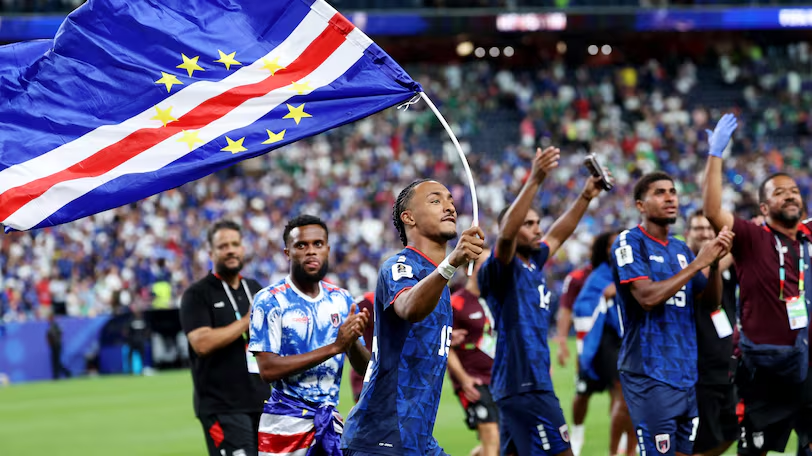 Cape Verde become smallest nation to reach World Cup knockouts
  Uruguay players left to arrange own flights after World Cup exit
  Morocco Move Closer to Knockouts After Fastest Goal of World Cup 2026
  Ghana Black Stars qualify for FIFA World Cup Round of 32 before Croatia showdown