
Jason Arday found dead aged 41 as Cambridge pays tribute

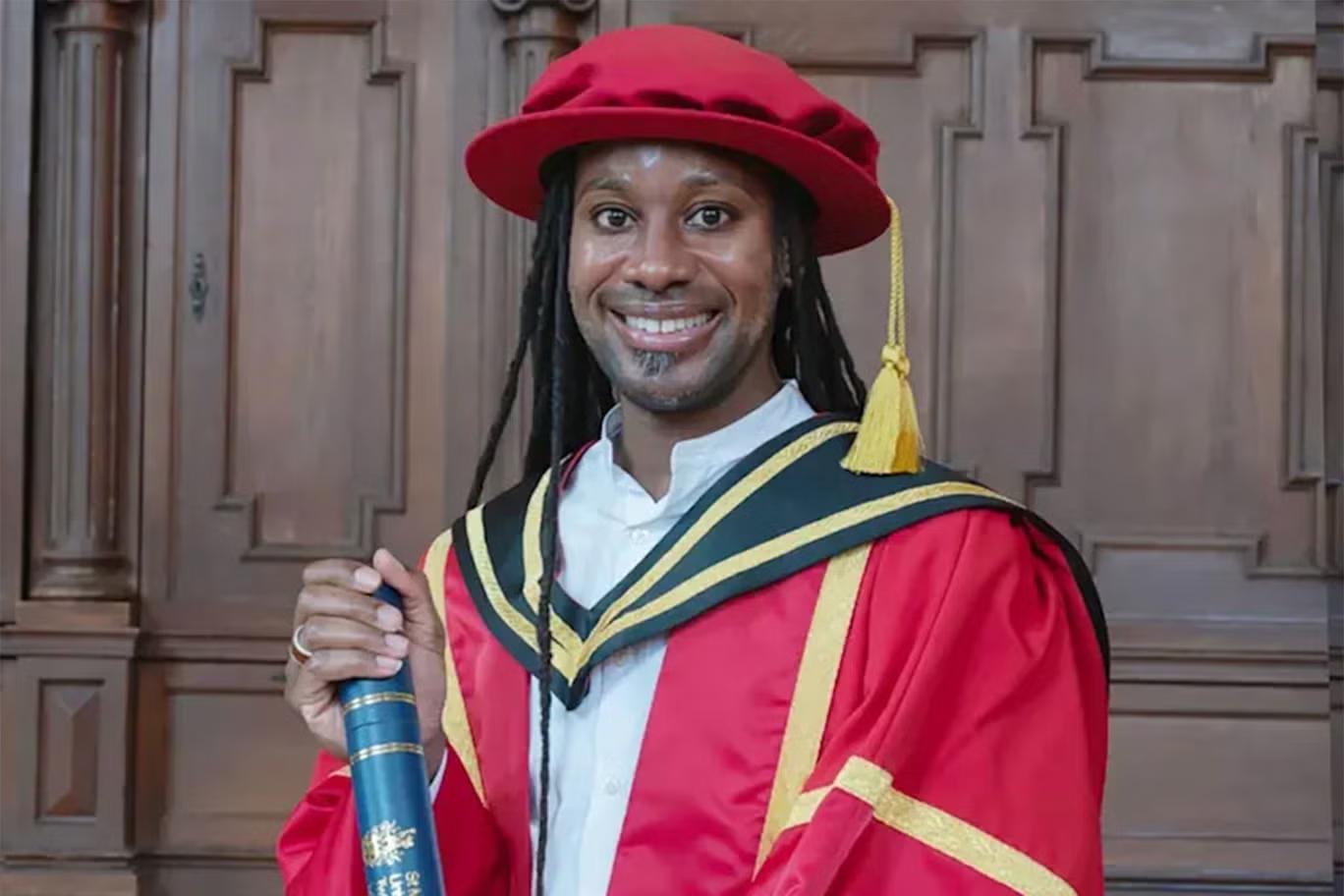

Prime Minister Andy Burnham has urged reflection after the former Cambridge professor was found dead in south London. Police say his death is not suspicious.
LONDON, United Kingdom — Former University of Cambridge professor Jason Arday has been found dead aged 41 at an address in Battersea, south London, days after resigning from the university amid allegations concerning his academic work. Police said the Jason Arday death was being treated as unexpected but was not believed to be suspicious. The academic was pronounced dead at the scene on Friday afternoon after emergency services were called to the property. His next of kin have been informed and are being supported by officers. The death of Cambridge professor Jason Arday has prompted tributes from his family, the university and political leaders, while also intensifying debate about the public scrutiny he faced before his resignation. Prime Minister Andy Burnham on Saturday called for reflection and cautioned against rushing to judgement.
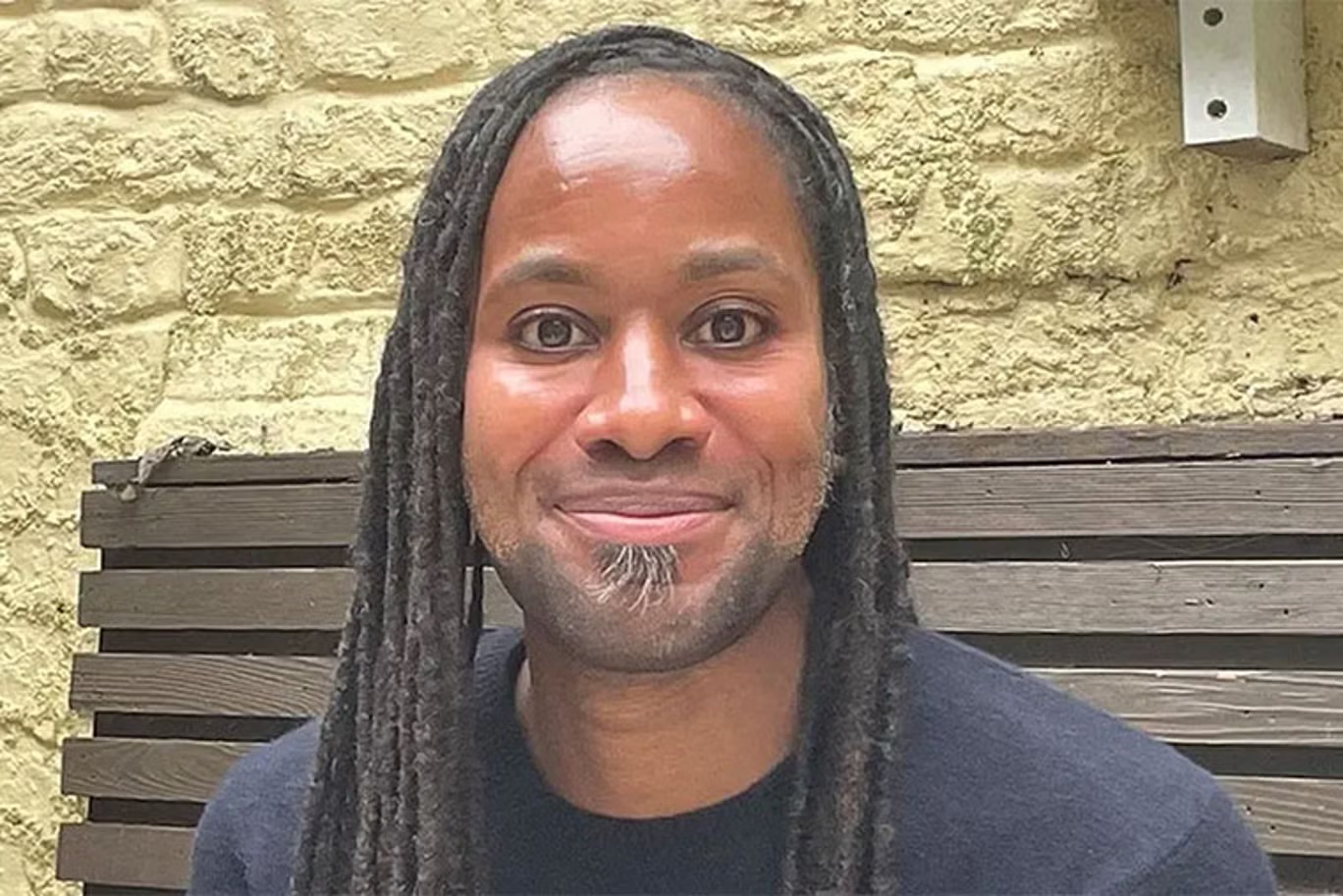
Police say Jason Arday’s death is not suspicious.
The Metropolitan Police said Jason Arday was found unresponsive at a property in Battersea and pronounced dead at the scene. “At this time his death is being treated as unexpected but is not believed to be suspicious,” police said. Officers from the Metropolitan Police’s Central South Command Unit are investigating the circumstances.
The police position is significant because no official cause of death has been announced. Any determination about the circumstances or cause of Arday’s death will be a matter for the relevant authorities and coronial process. The London Ambulance Service said in the initial reporting supplied to Nukunya that emergency crews were called to Daley Thompson Way in Battersea shortly after 3pm on Friday. Resources sent to the scene included an ambulance crew, an advanced paramedic and members of the Hazardous Area Response Team. No evidence released by police establishes that the controversy surrounding Arday before his death caused or contributed to it. Claims about the effect of that controversy should therefore be distinguished from any eventual official finding.
Arday’s family says he faced sustained abuse.
Arday’s family said in a statement issued through his publisher, Simon & Schuster UK, that they were in shock at losing a father, partner, brother, uncle and son. They said he had endured sustained abuse and harassment since becoming a professor at Cambridge and described what they regarded as a campaign of misinformation against him.
“The campaign of misinformation was too much for Jason,” the family said, describing him as a gentle man who wanted to see the best in others. The family also asked the media to leave them alone and end what they described as a campaign of harassment against Arday and his relatives. Their statements represent the family’s assessment of what Arday experienced and should not be interpreted as an official finding about the cause of his death.
Professor Sir Simon Baron-Cohen, director of Cambridge’s Autism Research Centre and a supporter of Arday, said he had spoken with him shortly before his death. Baron-Cohen said Arday had been struggling with the loss of his career and reputation after facing what he described as relentless scrutiny and ridicule. He argued that Arday required greater safeguarding and support.
Cambridge pays tribute as Burnham urges reflection.
University of Cambridge Vice-Chancellor Professor Deborah Prentice said she was “desperately saddened” by Arday’s death and offered sympathies to his family and friends. In a further message to the Cambridge community on Saturday, Prentice extended condolences to Arday’s family, friends, colleagues and students. Prime Minister Andy Burnham described the death as “a tragedy on so many levels”, particularly for those who knew Arday. Burnham urged people not to rush to conclusions about the circumstances surrounding his death.
“It’s not a moment for any rushing to judgement,” the prime minister said, calling instead for reflection on how events had reached this point. The comments came as Arday’s death generated a wider debate over the responsibilities of universities, the media and others when serious allegations against prominent individuals become the subject of sustained public attention. That debate includes competing concerns about the need to investigate credible allegations of academic misconduct and questions about whether scrutiny of Arday developed into disproportionate personal attacks.

Jason Arday had resigned from Cambridge.
Arday resigned as Professor of Sociology of Education at Cambridge on 5 August following allegations concerning his 2015 doctoral thesis and broader questions about parts of his academic and public record. He denied plagiarism while acknowledging that he had made mistakes during his doctoral work.
Reports had alleged that passages in his thesis were identical or closely similar to material contained in earlier academic work without adequate attribution. The allegations subsequently widened to questions about other elements of his academic record and claims he had made publicly about sporting and fundraising achievements.
Those claims and the findings of institutional reviews should not be conflated. The allegations against Arday were contested, and his resignation did not amount to an admission that every claim made about him had been established. In his resignation statement, reproduced in the source material supplied to Nukunya, Arday said stepping away was the only way he believed he could bring the episode to an end. He said the decision should neither be interpreted as a loss of faith in scholarship nor as acceptance of the narratives surrounding him.
The University of Cambridge inquiry had been announced.
The University of Cambridge inquiry was announced before Arday’s death and was intended to examine the circumstances surrounding his appointment to the Faculty of Education and his time at the institution.
Cambridge had faced pressure from academics and others over how Arday was appointed and how the university subsequently handled concerns about his work.
The controversy produced sharply different assessments.
Some critics argued that Cambridge had failed to conduct adequate checks before appointing Arday and had responded too slowly when questions emerged. Others argued that legitimate scrutiny of academic standards became entangled with personal attacks, racialised commentary and hostility towards diversity policies. The two issues are not mutually exclusive. Questions about academic integrity and institutional recruitment procedures can be examined independently of whether the treatment directed at an individual became abusive or discriminatory.
Cambridge’s inquiry therefore remains important for establishing what institutional processes were followed and whether changes are required. The existence of an inquiry, however, is not itself proof of misconduct by Arday.
From education researcher to Cambridge professor
Arday became Cambridge’s youngest Black professor when he joined the university as Professor of Sociology of Education in 2023. His work focused on education, inequality, race and social mobility, and his career made him a prominent figure in discussions about representation within British higher education.
Before Cambridge, he held academic positions at universities including Glasgow and Durham and completed his doctorate at Liverpool John Moores University. His personal account of overcoming substantial educational barriers also became an important part of his public profile. That story helped make his appointment symbolically significant beyond Cambridge, particularly for Black academics and students seeking greater representation within senior positions in British universities.
The later controversy consequently extended beyond questions about one academic’s record. It generated arguments about university recruitment, research integrity, institutional responsibility, race and the treatment of people exposed to intense public scrutiny. Those broader questions will continue to be examined. They should remain separate, however, from speculation about Arday’s death.
For now, the confirmed position is narrower: Jason Arday was found dead aged 41 in south London; police are treating his death as unexpected but not suspicious, and no official cause of death has been announced.
Why this story matters
Jason Arday’s death comes at a significant moment for British higher education. His appointment as the University of Cambridge’s youngest Black professor made him a prominent figure in debates about representation, race and social mobility in academia.
His death also comes while questions surrounding his academic record and Cambridge appointment remain unresolved. Those issues concern academic integrity and university recruitment procedures, while his family’s allegations that he experienced sustained abuse raise a separate debate about how intense public scrutiny is conducted.
For Black and African diaspora communities in Britain, Arday’s career also carried significance because of his visibility within one of the UK’s most prominent universities. Cambridge’s response and its previously announced inquiry will therefore continue to attract attention beyond the university.
These issues must remain separate from the circumstances of Arday’s death. Police have described the death as unexpected but not suspicious, and no official cause has been announced.
Related posts:
 Former Ghanaian G4S guard jailed after using old uniform in £117,000 London bank theft
  Bedford Triple Murder Suspect Arrested in South Africa After International Manhunt
  ECOWAS backs Ghana’s anti-xenophobia push as West African ministers endorse AU petition and reparatory justice framework
  North London stabbing declared terrorist incident as police probe possible targeting of Jewish community
  Ghana seeks AU intervention over xenophobic attacks in South Africa