Mahama Rules Out Public Funds for National Cathedral as Ghana Government Focuses on Economic Priorities

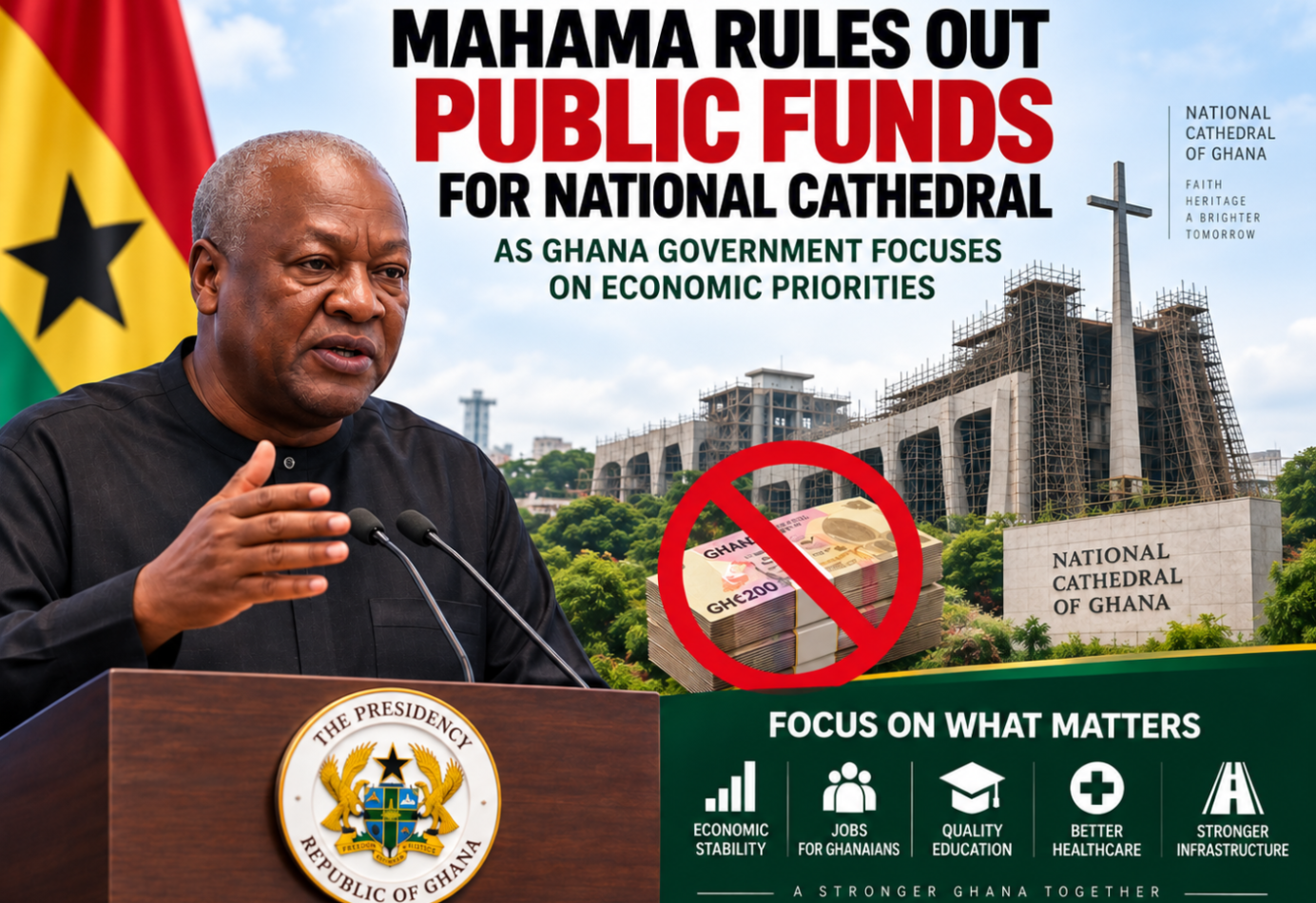

ACCRA, Ghana — President John Dramani Mahama has ruled out using public funds to complete Ghana’s stalled National Cathedral, saying the project should instead be supported through contributions from the Christian community.
Mahama made the comments during an engagement in Wa in Ghana’s Upper West Region on Saturday, September 12, as the government continued a nationwide programme of engagement with communities and traditional and religious leaders.
The National Cathedral has remained one of Ghana’s most politically sensitive infrastructure projects, with questions surrounding its financing, construction and the role of the state in supporting a project originally presented as a national religious landmark.
Mahama’s latest position is significant because it places responsibility for completing the project firmly outside the government’s core public spending priorities.
The president challenged Ghana’s Christian community to raise the money needed to complete the cathedral rather than expecting taxpayers to finance its construction.
He suggested that if Christians across Ghana contributed towards the project, the required funds could potentially be raised without placing additional pressure on the national budget.
National Cathedral remains controversial
The National Cathedral project was launched as an ambitious initiative intended to create a major Christian centre in Accra.
However, construction has been delayed amid disputes over funding and concerns about the use of public resources.
The project has attracted considerable political attention because it was strongly associated with the previous administration and became part of a wider debate over government spending.
Critics have questioned why public money should be used to support a religious project at a time when Ghana faces competing demands for healthcare, education, infrastructure and social protection.
Supporters, meanwhile, have argued that the cathedral could become a major national landmark and a centre for religious, cultural and international activities.
Mahama’s latest comments appear to attempt to move the issue away from the public purse.
Rather than cancelling the project outright, the president’s position is that the Christian community should provide the resources necessary for its completion.
That approach could allow the government to distance itself from the project’s financing while leaving open the possibility of completion through private and religious contributions.
Economic pressures remain central
The cathedral debate comes against the backdrop of Ghana’s continuing efforts to strengthen its economy.
Mahama has repeatedly defended his government’s economic record and said Ghana is now in a stronger position.
Speaking in Wa, the president described Ghana’s economy as resilient and said it was standing on stronger foundations. The comments come as the government seeks to reassure citizens that its economic programme is producing results.
For ordinary Ghanaians, however, the debate is less about economic statistics and more about household finances.
Prices, employment, access to credit and the cost of doing business remain important concerns for families and companies.
The government’s challenge is therefore to convince citizens that improvements in macroeconomic indicators are translating into tangible changes in living standards.
Government spending under scrutiny
The National Cathedral is also part of a larger discussion about government priorities.
Ghana’s public finances have been under pressure in recent years, forcing successive governments to make difficult decisions about spending.
Infrastructure projects compete with spending on education, healthcare, roads, public-sector salaries and social programmes.
Mahama’s decision not to commit public funds to the cathedral can therefore be interpreted as part of a broader attempt to prioritise government resources.
The administration has also promoted initiatives designed to improve economic activity and infrastructure.
Road construction remains one of the government’s major priorities. On Sunday, Ghana’s Roads and Highways Minister Kwame Governs Agbodza said the Wa-Dorimon-Wechiau-Ga road would be constructed under the second phase of the government’s Big Push programme.
Such announcements demonstrate the competing demands facing the administration.
While religious infrastructure has political and cultural significance, roads, schools, hospitals and economic infrastructure have direct implications for daily life.
A test for the Christian community
Mahama’s proposal also places responsibility on Ghana’s churches and Christian organisations.
The president’s argument effectively challenges churches, denominations and individual Christians to decide whether they are prepared to contribute financially to completing the cathedral.
The proposal could lead to renewed discussions among Ghana’s major Christian bodies about fundraising and ownership.
It may also revive questions about how much money has already been spent on the project and what remains necessary to complete it.
Those questions are likely to remain politically important because the cathedral has become closely linked to the debate over accountability and transparency in public spending.
Political implications
The issue could also remain relevant in Ghanaian politics.
The National Cathedral has been used by opposition politicians and civil society groups as an example of what they describe as questionable government spending.
Mahama’s latest comments allow the government to present itself as taking a different approach.
Instead of committing additional taxpayer money, the administration can argue that religious organisations should finance religious infrastructure.
The position could appeal to voters concerned about public expenditure, while also allowing the government to avoid an outright confrontation with Christian leaders who support the project.
The success of the approach will depend largely on whether sufficient private and religious funding can be mobilised.
What happens next?
The immediate question is whether Ghana’s Christian community will respond positively to Mahama’s challenge.
Completing a major national project requires substantial resources, and fundraising on that scale would require cooperation between different denominations and religious organisations.
It may also require greater transparency about the project’s current financial position, construction status and remaining costs.
For the government, the decision appears clear: public resources should be directed towards broader national priorities rather than completing the cathedral.
For supporters of the project, the challenge is equally clear: demonstrate that the Christian community is willing and able to finance its completion.
The debate is therefore unlikely to disappear.
Instead, Mahama’s latest comments may mark a new phase in the long-running National Cathedral controversy, shifting the focus from whether government should pay for it to whether Ghana’s Christian community is prepared to take financial responsibility.
For Ghana’s political landscape, the issue is another example of the difficult choices facing a government attempting to balance economic recovery, public expectations and competing demands for state resources.
Related posts:
 Bawumia Pledges Closer Partnership with New Christian Council Leadership
  NDC Renames Headquarters ‘Jerry Rawlings House’ on Founder’s 79th Birthday.
  NPP sets September 19 National Delegates Conference to elect new national officers
  Dennis Miracles Aboagye, thanks Accra supporters after EOCO bail, says, ‘We are now family.’
  The majority leader urges Ken Ofori-Atta to return and account for Ghana’s debt