Asiedu Nketiah Urges African Parties on Succession Planning


Follow Nukunya
Get the latest breaking news and updates from Nukunya.
because of… let’s… the SEO is not working at all because it’s like we have copied it.
Asiedu Nketiah Urges African Parties to Take Succession Planning Seriously
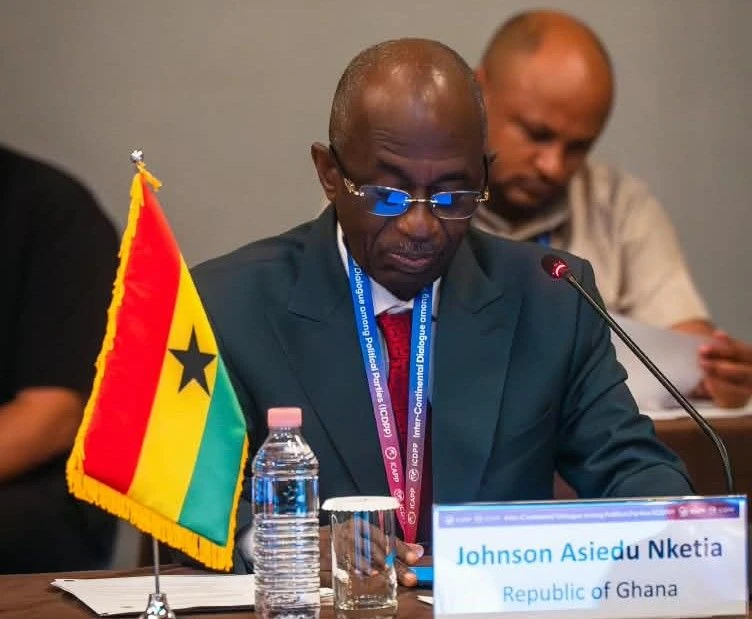
Johnson Asiedu Nketiah, National Chairman of the National Democratic Congress (NDC), has a clear message for political parties across Africa: stop building everything around one person.
Speaking at the inaugural Inter-Continental Dialogue among Political Parties in Seoul, South Korea, on September 7, Asiedu Nketiah argued that parties which grow anxious every time leadership changes hands are usually revealing a deeper problem they simply haven’t invested enough in building institutions that outlast individuals.
Asiedu Nketiah addressed the gathering on behalf of political parties taking part in the African Political Parties Initiative (APPI), an effort he’s been involved with from its earliest days as NDC’s representative.
He opened by acknowledging the organisations behind the Dialogue the International Conference of Asian Political Parties, the Permanent Conference of Political Parties of Latin America and the Caribbean (COPPPAL), and the Africa Governance Centre crediting them for creating a space where parties across continents can finally compare notes and build real relationships.
Drawing on decades of experience in party politics from the grassroots to Parliament to serving as both General Secretary and now Chairman of his own party Asiedu Nketiah made a case that the quality of government often gets decided long before anyone takes office.
His argument: political parties are the ones who decide who gets opportunity, what standards of conduct are acceptable, and how seriously ideas and policy actually get treated. Winning elections can hide a party’s internal weaknesses for a while, but governing tends to expose them fairly quickly.
He described a distinction between parties that only begin serious policy work once they’re already in office, versus those that prepare properly beforehand one is ready for an election, the other is ready to actually govern.
Asiedu Nketiah returned repeatedly to the idea that a party’s real strength shows in how it handles leadership transitions. A party capable of producing leadership beyond its current generation, he argued, has something more durable than electoral history or past success alone can provide.
He also pointed to a broader shift happening across societies citizens’ loyalty to parties is becoming less predictable, younger voters are questioning political authority more than before, and people increasingly want parties to articulate what they actually stand for, not just what office they’re chasing.
His takeaway was direct: political relevance has to be earned again with each generation. It can’t simply be passed down.
Another theme he emphasised was resilience across political fortunes. Parties that have governed for years can lose power, and opposition parties can suddenly find themselves running the very government they once criticised. Both situations, he said, demand institutional maturity treating time in opposition as an opportunity to keep developing policy and leadership, rather than simply waiting for the ruling party to stumble.
For governing parties, he stressed the importance of staying genuinely connected to the communities that brought them into power in the first place, since only sustained performance and public trust can keep a party relevant over time.
Asiedu Nketiah made clear he sees more value in parties discussing their real struggles than simply exchanging polished statements about past achievements. He pointed to a long list of practical questions worth exploring together how parties rebuild after losing elections, how they maintain internal unity, how they stay connected to citizens once in power, and how older institutions adapt as political environments shift around them.
He noted that every political tradition represented at the Dialogue has experienced both success and failure, and argued that studying only the victories teaches very little. Different histories, he suggested, make the exchange richer, not less useful.
His hope is that this gathering becomes an ongoing relationship rather than a one-time event — one where parties actually get to know each other, share experience directly, and give emerging political leaders real exposure to traditions outside their own countries.
He closed by acknowledging that no political institution has ever fully finished the work of renewing itself, and expressed hope that this inaugural meeting lays the groundwork for many years of serious exchange between political parties across continents.
Related posts:
 VP Opoku-Agyemang to Represent Mahama at Africa Forum in Kigali
  Ghana seeks AU intervention over xenophobic attacks in South Africa
  Kenya to Charge Eight Students With Murder Over Deadly School Dormitory Fire
  China and African railway experts deepen cooperation through Qinghai–Xizang exchange
  NPP Mion Chairman Sulaiman Abubakar Resigns From Position