

Cristiano Ronaldo says this may be his final year as 1,000-goal milestones loom.


Follow Nukunya
Get the latest breaking news and updates from Nukunya.
The 41-year-old Portugal captain Cristiano Ronaldo has given his clearest indication yet that retirement is approaching, saying this will “probably” be his final year in football as he pursues 1,000 career goals with Al-Nassr.
RIYADH, Saudi Arabia — Cristiano Ronaldo has given his clearest indication yet that one of football’s most celebrated careers is approaching its end, saying the coming year will “probably” be his last as a professional player. The 41-year-old Portugal captain said he wants to leave a “spectacular legacy” as he prepares for another season with Saudi Pro League club Al-Nassr.
His comments put a possible timetable on a retirement that Ronaldo has discussed increasingly openly in recent years. They also set up what could become a final season dominated by one last individual landmark: reaching 1,000 senior career goals.
Ronaldo has scored 976 goals for club and country, leaving him 24 short of the milestone, according to reports.
“This is probably my last year of football,” Ronaldo told Vogue in an interview published on Sunday, adding that he wanted to leave behind a “spectacular legacy”.
It is not a formal retirement announcement. Ronaldo’s use of “probably” leaves open the possibility that he could continue beyond the season. But after 25 years in senior football, the statement represents one of his strongest public indications that the end is close.

A final target: 1,000 goals
The numbers surrounding Ronaldo’s career have long formed part of his extraordinary longevity.
He has won five Ballon d’Or awards and five UEFA Champions League titles, alongside domestic championships in England, Spain and Italy. His club career has taken him from Sporting CP to Manchester United, Real Madrid, Juventus and Al-Nassr.
For Portugal, his longevity has been equally significant.
The 2026 World Cup became Ronaldo’s sixth appearance at the tournament, extending a career that began at the competition in Germany in 2006. FIFA says he became the first player to score at six different men’s World Cups.
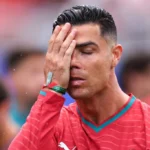
His final World Cup ended in Dallas in July when Portugal were beaten 1-0 by Spain in the round of 16. Mikel Merino scored the decisive goal in the 90th minute. Ronaldo subsequently confirmed that he did not intend to play at another World Cup.
That means the closing chapter of his playing career is now likely to unfold primarily with Al-Nassr.
The immediate numerical target is unmistakable.
At 976 career goals, Ronaldo needs another 24 to reach 1,000.
Reaching that figure would provide a defining storyline for what he now suggests could be his farewell season.
The World Cup dream ends without the trophy.
One distinction has remained beyond Ronaldo despite his individual and club success: winning the World Cup. Portugal’s 2026 campaign offered what was widely expected to be his final opportunity.
Ronaldo nevertheless added another chapter to his World Cup record. He scored twice against Uzbekistan and later converted a penalty as Portugal came from behind to defeat Croatia 2-1 in the round of 32. FIFA said the Croatia goal was his first in a World Cup knockout match.
Spain then ended Portugal’s campaign in the next round.
The defeat closed Ronaldo’s World Cup career after six tournaments spanning two decades. FIFA said his 2026 appearance made him the first player to score in six editions of the men’s tournament.
The absence of a World Cup does not diminish the breadth of his international record.
Ronaldo helped Portugal win their first major senior international trophy at Euro 2016 and has established himself as the leading goalscorer in men’s international football.
His career therefore enters its final phase with the distinction between what remains achievable and what has already passed becoming increasingly clear.
The World Cup chapter is over. The pursuit of 1,000 goals is not.
Ronaldo begins planning life beyond football.
Ronaldo’s latest comments were notable not only because he discussed retirement, but also because he spoke in unusually concrete terms about what comes afterwards. He said his future was already mapped out and acknowledged that leaving football after such a long career could create a significant void.
Travel, family life and padel are among the activities he expects to occupy more of his time.
He also reflected on the sacrifices involved in maintaining an elite career for a quarter of a century.
The comments suggest that Ronaldo is approaching retirement not simply as the end of competition but as a transition that will require a different structure to his life.
That distinction matters for an athlete whose professional identity has been built around relentless competition, physical conditioning and measurable targets.
Ronaldo made his senior debut for Sporting in 2002 before moving to Manchester United the following year.
At Real Madrid, he entered the most prolific period of his career, scoring 450 goals in 438 appearances and becoming the Spanish club’s all-time leading scorer. He later moved to Juventus, returned to Manchester United and joined Al-Nassr in Saudi Arabia at the end of 2022.
His move to Saudi Arabia also preceded the arrival of several other established international players as the Saudi Pro League expanded its global profile.
Why this story matters
Ronaldo’s eventual retirement will represent more than the departure of an exceptionally successful player. For roughly two decades, he has occupied the centre of an era of football shaped by extraordinary individual scoring records, globalised player brands and his rivalry with Lionel Messi.
His longevity has also changed expectations about how long an elite forward can remain productive.
At 41, Ronaldo was still playing for Portugal at the 2026 World Cup and scoring in the competition. He became the first player to score at six men’s World Cups, according to FIFA.
That makes the possibility of retirement significant across several generations of football supporters, including audiences in Africa, where Manchester United, Real Madrid and the Portuguese national team command substantial followings.
For Al-Nassr and the Saudi Pro League, his eventual departure will also close an important chapter. Ronaldo became the most prominent global player associated with the league during the early stage of Saudi Arabia’s major investment in elite football.
For Ronaldo himself, however, the final season appears to have a simpler focus.
There are matches still to play, trophies still available and 24 goals separating him from 1,000.
Whether that landmark becomes the closing achievement of his playing career is likely to be one of football’s defining individual storylines over the coming season.
What happens next?
Ronaldo is expected to continue with Al-Nassr during the 2026–27 campaign.
His latest comments should not be interpreted as confirmation of a fixed retirement date. He said this was “probably” his final year rather than announcing that he would definitely retire at the end of the season.
That distinction is important.
Professional athletes frequently reassess retirement plans according to fitness, form, family considerations and playing opportunities.
What has changed is Ronaldo’s own framing.
After previously speaking about having another year or two left in football, he is now publicly contemplating the possibility that the countdown has entered its final season.
For a career defined by goals, records and an unusually long period at the top of the game, the final number may yet prove to be the most closely watched.
Related posts:
 Portugal Edge Nigeria 2-1 as Conceição’s Wonder Goal Ends Super Eagles’ Resistance
  Ronaldo honours Diogo Jota as Portugal edge Croatia to reach World Cup last 16
  Cristiano Ronaldo’s World Cup Dream Ends in Tears as Portugal Exit to Spain
  Mexico’s Missing Persons Crisis Cast Into World Cup Spotlight as Activists Demand Action
  DR Congo World Cup Preparations Disrupted by Ebola Fears