Grace Nortey dies at 89: Remembering the formidable actress who helped shape Ghanaian screen drama
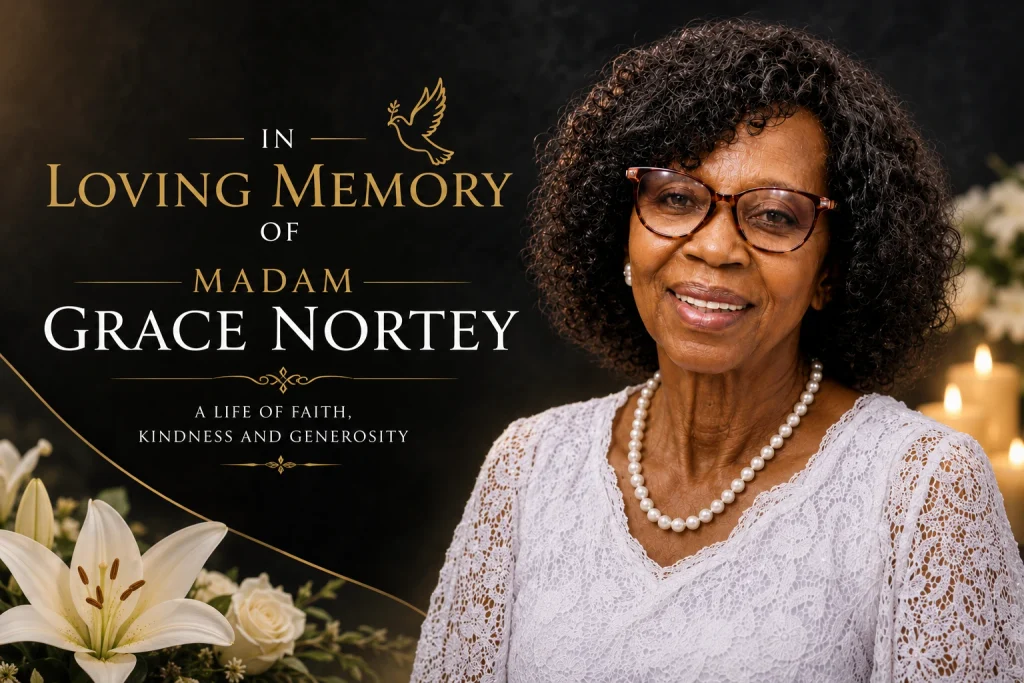
Grace Nortey, one of Ghana's most recognisable veteran actresses, has died aged 89 after a career spanning more than five decades of radio, theatre, television and film.



Grace Nortey, one of Ghana’s most recognisable veteran actresses, has died aged 89. Across theatre, radio, television and film, her commanding performances connected generations of Ghanaian audiences and helped define an era of local screen drama.
ACCRA, Ghana – Veteran Ghanaian actress Grace Nortey has died aged 89, bringing to a close a career that stretched across more than five decades of Ghanaian theatre, radio, television and film. Nortey died on Wednesday, 26 August, at the University of Ghana Medical Centre in Accra, according to multiple reports.
She was born on 1 February 1937.
Her death removes one of the most familiar figures from a generation of performers who became household names when locally produced television drama occupied a central place in Ghanaian popular culture. Nortey became particularly known for characters with authority: outspoken mothers, uncompromising matriarchs and women who could confront the people around them without surrendering their voice.
But reducing her career to a familiar character type would miss its wider significance.
She worked through several transformations in Ghanaian entertainment, from radio and stage performance through nationally watched television drama to feature films and, eventually, an internationally distributed production. Her screen credits stretched from Ghanaian classics to Beasts of No Nation, the 2015 war drama directed by Cary Joji Fukunaga and starring Idris Elba and Ghanaian actor Abraham Attah. Nortey played the Old Witch Woman. Her career therefore provides a window into how Ghanaian acting itself changed over half a century.
A commanding presence on Ghanaian screens
For generations of Ghanaian viewers, Nortey’s appeal was immediate. She could dominate a scene through force of personality. Her performances frequently relied on sharp exchanges, strong delivery and an ability to embody women who were difficult to intimidate.
That made her particularly memorable during the years when Ghanaian television drama depended heavily on character, dialogue and stories rooted in everyday social life. Nortey was associated with productions including Osofo Dadzie, while her broader television and theatre career unfolded during the period in which locally made drama became a major part of evening entertainment in Ghana.
Those productions mattered beyond entertainment.
Before the fragmentation of television audiences across satellite channels, streaming services and social media, locally produced dramas could become shared national experiences. Actors were therefore not simply performers appearing in one programme among hundreds of alternatives. They entered homes repeatedly and became recognisable cultural figures.
Nortey belonged to that generation.
A commanding presence on Ghanaian screens
For generations of Ghanaian viewers, Nortey’s appeal was immediate.
She could dominate a scene through force of personality.
Her performances frequently relied on sharp exchanges, strong delivery and an ability to embody women who were difficult to intimidate. That made her particularly memorable during the years when Ghanaian television drama depended heavily on character, dialogue and stories rooted in everyday social life.
Nortey was associated with productions including Osofo Dadzie, while her broader television and theatre career unfolded during the period in which locally made drama became a major part of evening entertainment in Ghana.
Those productions mattered beyond entertainment.
Before the fragmentation of television audiences across satellite channels, streaming services and social media, locally produced dramas could become shared national experiences. Actors were therefore not simply performers appearing in one programme among hundreds of alternatives.
They entered homes repeatedly and became recognisable cultural figures. Nortey belonged to that generation.

Her career began before television fame
Grace Nortey’s public career did not begin with film or television.
Before becoming widely known on television, Nortey was involved in radio and hosted Nyeawokoshie, a programme aimed at Ga women on Radio One during the 1970s. Career retrospectives and later biographical accounts document that part of her working life.
Early public communication and programme work before her wider screen recognition.
Performance traditions that shaped much of Ghana’s early dramatic culture.
A later career that carried her into new forms of Ghanaian entertainment.
Nortey’s public presence developed across different forms of Ghanaian media. Her career should therefore not be reduced to television or cinema alone.
From Ghanaian drama to film
Nortey’s film work connected an earlier generation of Ghanaian performance with a much more international screen era.
Sinking Sands
Nortey played Grandma. Her involvement is reflected in the film’s cast records.
Ties That Bind
Another film credit within her later screen career.
Beasts of No Nation
Her later appearance placed her within a production that reached a substantially larger international audience.
Nortey’s role in Beasts of No Nation was comparatively small, but its significance lies in the contrast it represents.
An actress whose reputation was built during an earlier era of Ghanaian theatre and television remained active long enough to appear in a production associated with the global streaming age.
A career that crossed generations
Longevity may be one of the clearest measures of Nortey’s contribution.
National television and stage drama dominated the entertainment landscape.
Audience choice and commercial broadcasting expanded.
Production methods became cheaper, faster and more widely distributed.
Ghanaian productions could reach international audiences almost immediately.
Older audiences encountered Nortey through a familiar television tradition. Later viewers encountered her alongside performers working in a substantially different screen industry.
Her career therefore linked periods of Ghanaian entertainment history that are often discussed separately.
Recognition for a long career
Nortey received several honours during her later years.
Lifetime Achievement Award
Black Star International Film Festival.
Acting recognition
Including recognition associated with Adams Apple.
Performing arts contribution
Subsequent recognition acknowledged her wider contribution to Ghana’s creative sector.
The honours are useful markers of industry recognition.
Audiences remembered her.
The screen presence audiences recognised
That performance identity made Nortey distinctive at a time when female characters could easily be restricted to supporting roles around male protagonists.
She also spoke about the treatment of veteran performers
Nortey’s later years exposed a more difficult side of Ghana’s creative industry.
In a 2020 interview, she criticised what she described as repeated promises to support ageing performers that had failed to translate into meaningful assistance.
After more than four decades in acting, she argued that veterans wanted action rather than repeated assurances from those responsible for the creative sector.
Can performers earn sustainable incomes across a long career?
What happens when their most active working years end?
Are there functioning institutions capable of supporting veteran artists?
Remembering Nortey also means preserving the questions she asked the industry to improve.
An acting style audiences immediately recognised
Nortey’s performances often depended on conviction rather than understatement.
She became associated with strong-willed women who could challenge family members, authority figures and social expectations.
Her characters could command attention quickly.
Dialogue and confrontation were central to many memorable performances.
The same forceful presence could generate comedy, conflict or seriousness.
That does not mean every role was identical. Rather, Nortey developed a recognisable screen identity.
Grace Nortey and the history Ghana needs to preserve
Her death also raises a wider question about preservation.
Ghana’s older television and theatre history is not always easily accessible to younger audiences. Productions survive unevenly, credits can be incomplete and biographical information can be fragmented across interviews, newspapers and secondary accounts.
These are not merely nostalgic materials. They are part of Ghana’s cultural record.
The performers who built Ghana’s theatre and television traditions deserve to be documented with the same seriousness applied to other parts of national history.
From the television set to global streaming
There is something particularly striking about the endpoints of Nortey’s career.
Her professional life began in an era when radio, theatre and national television were dominant. Decades later, one of her credits could be encountered by viewers around the world through Netflix.
Four ways to understand Grace Nortey’s legacy
01 Why is her career historically important?
Because it crossed radio, theatre, television and film and remained active through major technological and commercial changes in Ghana’s entertainment industry.
02 Was her significance mainly about awards?
No. Awards document industry recognition, but her wider importance also lies in audience memory, professional longevity and her place in Ghana’s broadcasting history.
03 Why do her comments about veteran performers matter?
They complicate a purely celebratory account of her career and raise persistent questions about welfare, income security and institutional support for ageing creative professionals.
04 What should Ghana preserve from her generation?
Recordings, scripts, credits, photographs, interviews, programme documentation and oral histories that make the country’s broadcasting and performing-arts history accessible.
Grace Nortey’s legacy is bigger than nostalgia
The understandable response to Nortey’s death will be nostalgia.
Viewers will remember particular characters, arguments, expressions and television evenings. But nostalgia should not be the only way Ghana remembers performers of her generation.
Their importance is institutional.
They helped establish an expectation that Ghanaian stories, Ghanaian voices and Ghanaian characters deserved a place on Ghanaian screens.
Nortey’s own criticism of the treatment of veteran performers should also survive alongside the celebration of her work.
The performances
The roles and screen presence that audiences knew across generations.
The challenge she left behind
Whether Ghana adequately supports and documents the people who helped build its creative industries.
Grace Nortey lived long enough to see Ghanaian screen entertainment change radically. She moved through radio, theatre, television and film and remained part of the country’s cultural landscape as the industry around her transformed.
At 89, her death closes an exceptional professional chapter.
The larger responsibility now belongs to Ghana: preserve the performances, document the history around them and ensure that the generation that helped build the country’s screen culture is remembered as more than a collection of fading television memories.Related posts:
 Ghana Actress Beverly Afaglo Dies at 42 as Tributes Pour In
  MOBO Awards Founder Kanya King Dies Aged 57, Leaving Lasting Legacy in Black Music
  Dr Likee’s London Success Draws Corporate Backing as Ghanaian Comedy Expands Abroad
  Miss Ghana unveils Stacy Amoateng, Okyeame Kwame and Kafui Dey as judges for 69th Miss Ghana auditions
  ShattaFest UK Stampede: New Video Shows Fire That Left 23 Injured