Seven killed in crowd surge at India’s Ashok Dham temple in Bihar


Follow Nukunya
Get the latest breaking news and updates from Nukunya.
At least seven worshippers have been killed and several others injured at the Ashok Dham temple in India’s Bihar state, according to updated local reports. Authorities are investigating whether an electrical incident, heavy crowd pressure or a combination of factors triggered the deadly surge.
LAKHISARAI, India — At least seven people have been killed and several others injured after a crowd surge at a Hindu temple in India’s eastern state of Bihar, with authorities investigating conflicting early accounts of what triggered the incident. The deaths occurred at the Ashok Dham temple in Lakhisarai district on Monday as large numbers of devotees gathered during the Hindu holy month of Shravan.
Initial reporting put the death toll at six. Reuters cited officials saying at least six people had died and at least five were injured, while subsequent Indian reports citing police raised the toll to seven. Police are investigating whether an electrical incident contributed to the panic.
Senior police officer Shivam Kumar said initial information suggested an electricity pole had fallen and people may have been electrocuted, contributing to what he described as a “stampede-like situation”. He cautioned, however, that the precise cause could only be established after verification.
Later reports also pointed to severe crowd pressure and a barricade giving way as authorities worked to reconstruct what happened. The distinction is significant because investigators have not yet established whether the fatalities resulted from electrocution, crushing in the crowd or other injuries.

Thousands gathered for Shravan worship.
The incident occurred during a period when the Ashok Dham temple draws large numbers of Hindu worshippers. Devotees had gathered on Monday morning to offer water to Lord Shiva during Shravan, a holy month in the Hindu calendar. Reports indicate that worshippers had crowded the temple for the observance when the incident occurred.
Updated Indian reporting said Monday was the third Monday of Shravan, when Shiva temples can experience particularly heavy attendance. Emergency personnel, police and district administration officials were sent to the scene, while injured worshippers were taken to hospital.
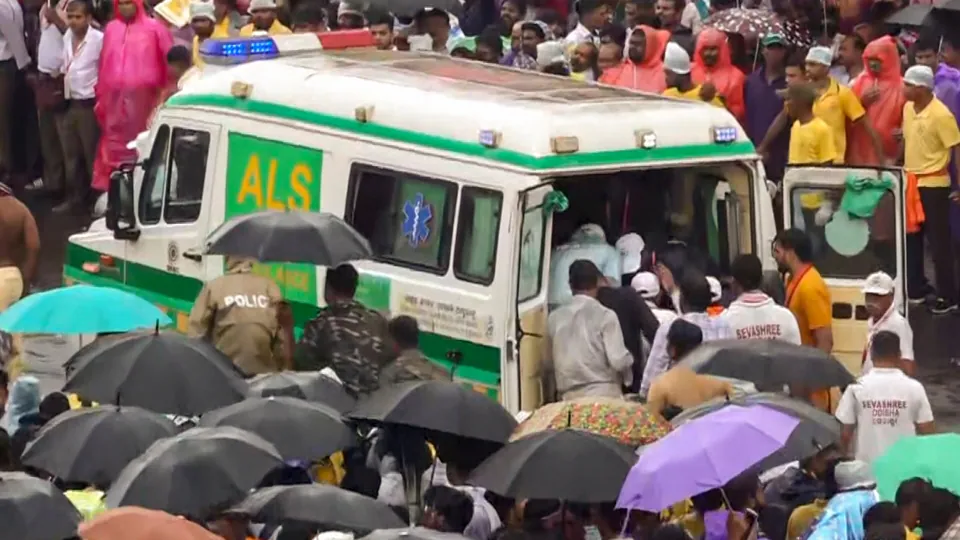
Images from the aftermath showed ambulances and emergency workers surrounded by large crowds, with some injured people being transported for treatment. The photographs supplied with the reporting underline the scale of the emergency response: one shows an ambulance surrounded by worshippers and emergency personnel, while another shows a government ambulance outside a medical facility.
The cause remains under investigation.
Early accounts of the incident have differed, making caution necessary.
Reuters reported that police suspected a falling electricity pole had alarmed worshippers and triggered the crowd movement. Kumar said there were reports that people had been electrocuted before the stampede-like conditions developed.
But authorities had not confirmed that sequence when the first reports were published. Later accounts attributed to district officials suggested crowd density itself was also a critical factor.
Indian reporting said the arrival of large numbers of devotees increased pressure around the temple and that barricading gave way as people moved through the area.
That leaves several questions for investigators: whether electricity was involved, what caused the initial crowd movement, whether crowd-control infrastructure failed and how the victims died. Until those findings are established, describing the incident simply as an electrocution or solely as a conventional stampede would go beyond the verified evidence.
The Bihar government orders treatment for injured
Bihar Chief Minister Samrat Choudhary expressed condolences to the families of those killed and directed the administration to ensure treatment for the injured. The New Indian Express reported that Choudhary described the incident as deeply distressing and said officials had been instructed to arrange prompt medical care.
The Bihar government subsequently announced financial assistance of 400,000 rupees for the next of kin of each person killed, according to Indian reports. Authorities were also working to identify victims and notify their relatives.
India’s recurring challenge of crowd safety
The deaths again put attention on crowd management at large religious gatherings in India. The country hosts some of the world’s largest religious events, sometimes involving millions of people moving through temples, pilgrimage routes and temporary gathering areas within short periods.
That creates substantial logistical demands for local authorities, including controlled entry and exit routes, barriers, emergency access, communications and medical provision.
The Bihar deaths follow other fatal crowd incidents at religious gatherings.
In January 2025, at least 30 people were killed during the Maha Kumbh festival in Prayagraj as enormous numbers of pilgrims gathered to bathe at the confluence of rivers considered sacred in Hindu tradition, according to reports. Such comparisons require care. The circumstances and scale of individual incidents differ, and the existence of previous crowd disasters does not establish responsibility for what happened at Ashok Dham.
The immediate question in Lakhisarai is more specific: what caused Monday’s crowd movement and whether existing safety arrangements were adequate for the number of worshippers attending.
Why this story matters
The Ashok Dham deaths are not only a story about the immediate tragedy.
They raise a broader public-safety question faced by countries that host large religious, sporting and cultural gatherings: how authorities manage predictable concentrations of people without restricting legitimate participation.
India’s population and the extraordinary scale of some of its religious gatherings make that challenge particularly acute. Infrastructure, crowd modelling, emergency routes, policing and real-time communication can become critical when tens of thousands of people converge on a relatively confined location. That issue also has relevance beyond India, including across Africa.
Ghana and other African countries regularly host major religious conventions, festivals, sporting fixtures, political gatherings and cultural events involving large crowds. The circumstances are different, but the underlying crowd-safety principles — controlled movement, emergency access, resilient barriers, medical readiness and clear public communication — are broadly applicable.
For Ashok Dham, however, accountability must begin with evidence.
Authorities will need to establish what triggered the crowd movement, whether an electrical hazard was present, how crowd-control measures performed and whether any preventable failures contributed to the deaths. Until that investigation is complete, those questions should remain questions rather than conclusions.
Related posts:
 Pakistan says security forces kill 29 fighters in cross-border operation with Afghanistan
  Iran and Israel Halt Attacks After Trump Intervention, but Ceasefire Remains Fragile
  Twin Earthquakes Strike Venezuela, Collapsing Buildings in Caracas
  Strait of Hormuz Crisis Deepens as Iran Declares Closure, Raising Fears Over Global Oil Supplies
  Fort Hood Apache helicopter crash kills two in Texas