
Lionel Messi retires from Argentina duty at 39 after record 125 goals



Follow Nukunya
Get the latest breaking news and updates from Nukunya.
Lionel Messi has retired from international football at 39, ending his Argentina career with a record 125 goals in 207 appearances after winning the 2022 World Cup and leading his country to another final in 2026.
BUENOS AIRES, Argentina – Lionel Messi has announced his retirement from international football, bringing an end to a record-breaking Argentina career spanning more than two decades.
The 39-year-old announced his decision on Monday, weeks after captaining Argentina to the 2026 World Cup final, where Spain ended their attempt to win consecutive world titles. Messi leaves international football as Argentina’s record goalscorer and most-capped player, with 125 goals in 207 appearances.
His honours with Argentina include the 2022 World Cup, Copa América titles in 2021 and 2024 and Olympic gold in 2008. The eight-time Ballon d’Or winner said stepping away remained painful but believed the moment had arrived to allow a new generation to take greater responsibility for the national team.
His retirement applies only to international football.
Messi continues to play professionally for Inter Miami, where he remains capable of producing extraordinary performances. Just a day before his international retirement announcement, he scored four goals and provided an assist in Miami’s 7-1 MLS victory over CF Montreal.
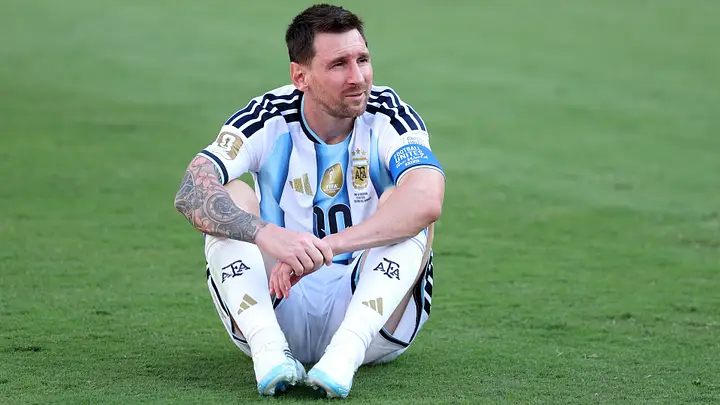
Messi leaves Argentina after another World Cup final
Messi’s final international tournament demonstrated that his influence had survived remarkably deep into his career.
Argentina arrived at the 2026 World Cup as defending champions, with Messi appearing at the tournament for a record-extending sixth time.
He began the competition by scoring a hat-trick against Algeria, taking his international record at that point to 120 goals in 200 appearances. The Argentine Football Association described him during the tournament as the national team’s record goalscorer and a defining figure across generations.
Argentina ultimately returned to the World Cup final four years after Messi lifted the trophy in Qatar.
Spain denied them a second consecutive title, but reaching another final at 39 provided an extraordinary final chapter to Messi’s international playing career. His departure now leaves Argentina confronting a transition that has been anticipated for years: building a national team without the player who has been its central figure for more than two decades.

MESSI • ARGENTINA • 2005–2026 2016 FIRST RETIREMENT Heartbreak 2026 FINAL INTERNATIONAL RETIREMENT Champion
Messi retired from Argentina twice. The two departures tell completely different stories.
In 2016, Lionel Messi walked away after another major-final defeat. Ten years later, he leaves as a World Cup-winning captain and Argentina’s record appearance-maker and goalscorer.
THE TRANSFORMATION
Messi went from being judged largely by what he had not won with
Argentina to captaining one of the country’s most successful generations.
THE YEARS OF HEARTBREAK 2014 World Cup final → 2015 Copa América final → 2016 Copa América final → AFTERMATH Messi walks away
Before the breakthrough, four major finals ended in defeat
Argentina lose to Germany.
Another major title slips away.
Argentina lose to Chile on penalties.
At 29, he announces his international retirement.
THE TURNING POINT 2016 Retires → LATER Returns → 2021 Copa América → 2022 World Cup → 2024 Copa América
He changed his mind — and eventually changed his Argentina legacy
THE DECISION THAT MATTERED
His return after 2016 allowed the most successful phase of his
international career to happen at all.
FROM NEAR-MISSES TO TITLES 2021 Copa América 2022 World Cup 2024 Copa América BEFORE “What has Messi won with Argentina?” → AFTER World Cup-winning Argentina captain
2021 changed the conversation. 2022 transformed it.
Messi wins his first major senior international trophy as Argentina defeat Brazil in the final.
Argentina become world champions, ending a 36-year wait for another title.
Argentina retain the continental title.
THE FINAL INTERNATIONAL RECORD SENIOR APPEARANCES 207 Argentina record SENIOR GOALS 125 Argentina record WORLD CUPS 6 across his international career
The numbers underline the scale of the career
THE SCALONI ERA EARLIER YEARS Exceptional individual LATER YEARS Collective structure around the captain
Argentina became more than Messi plus expectation
National expectations were heavily concentrated around Messi’s brilliance.
Argentina increasingly developed a cohesive system rather than depending entirely on one player’s individual intervention.
THE MOST SUCCESSFUL PHASE
2021 Copa América + 2022 World Cup + 2024 Copa América + 2026 World Cup final
WHAT ARGENTINA LOSES GOALS 125 ROLE Principal attacking figure LEADERSHIP Captain IDENTITY Global symbol
Replacing Messi means replacing more than 125 goals
Argentina’s transition is therefore tactical, emotional and symbolic. A new generation must now continue without the player around whom the national team has been defined for more than two decades.
THE NEXT ARGENTINA QUESTION
Can the collective structure that helped Messi finally succeed continue
after Messi himself is gone?
AN IMPORTANT DISTINCTION CLOSED Argentina career CONTINUES Inter Miami career
Messi has retired from Argentina — not from professional football
Senior international football ends after more than two decades.
His club career remains separate from the international retirement.
MESSI’S ARGENTINA LEGACY
Five questions that explain the transformation
01 Why did Messi retire in 2016?
His announcement followed Argentina’s Copa América final defeat to Chile on penalties, after several years of major-final disappointment.
02 What changed after he returned?
Argentina eventually won the 2021 Copa América, the 2022 World Cup and another Copa América in 2024, transforming the narrative around Messi’s international career.
03 Was the transformation only about Messi?
No. The later Argentina side developed a more cohesive structure under Lionel Scaloni, reducing the extent to which everything depended on Messi producing an individual solution.
04 Does international retirement mean his playing career is over?
No. The announcement closes his Argentina career. His club career with Inter Miami is separate.
05 What is Argentina’s challenge now?
The national team must replace not only Messi’s goals but also his attacking influence, leadership and symbolic importance while continuing the collective structure built around the later phase of his career.
NUKUNYA ANALYSIS 2016 What he had not won → 2026 What he had achieved HEARTBREAK Repeated final defeats + RETURN Decision to continue + COLLECTIVE Stronger Argentina structure + TROPHIES 2021 • 2022 • 2024
Messi’s second retirement tells a very different story from his first
The distance between 2016 and 2026 explains much of Lionel Messi’s international legacy.
Argentina’s failures remained central to the debate around his career.
Copa América champion, World Cup-winning captain and national record-holder.
Spain denied Messi the possibility of ending his Argentina career as a two-time World Cup-winning captain.
It did not reverse the transformation that had already taken place.
THE DIFFERENCE A DECADE MADE
When Messi first retired from international football in 2016,
his Argentina story appeared unfinished.
Ten years later, it does not.
Related posts:
 Messi Scores as Argentina Survive Cape Verde Scare to Reach World Cup Last 16
  Mexico Beat South Africa 2-0 in World Cup Opener Marked by Three Red Cards
  Ronaldo honours Diogo Jota as Portugal edge Croatia to reach World Cup last 16
  Argentina Stage Stunning Comeback to Beat Egypt 3-2 as Lionel Messi Recovers from Penalty Miss
  How Spain Rebuilt, Evolved and Conquered the 2026 World Cup