Appeal Court reverses GN Savings licence revocation in major BoG setback


Follow Nukunya
Get the latest breaking news and updates from Nukunya.
Ghana’s Court of Appeal has overturned the revocation of GN Savings and Loans’ operating licence, reopening debate over the Bank of Ghana’s banking sector clean-up programme.
ACCRA, Ghana —
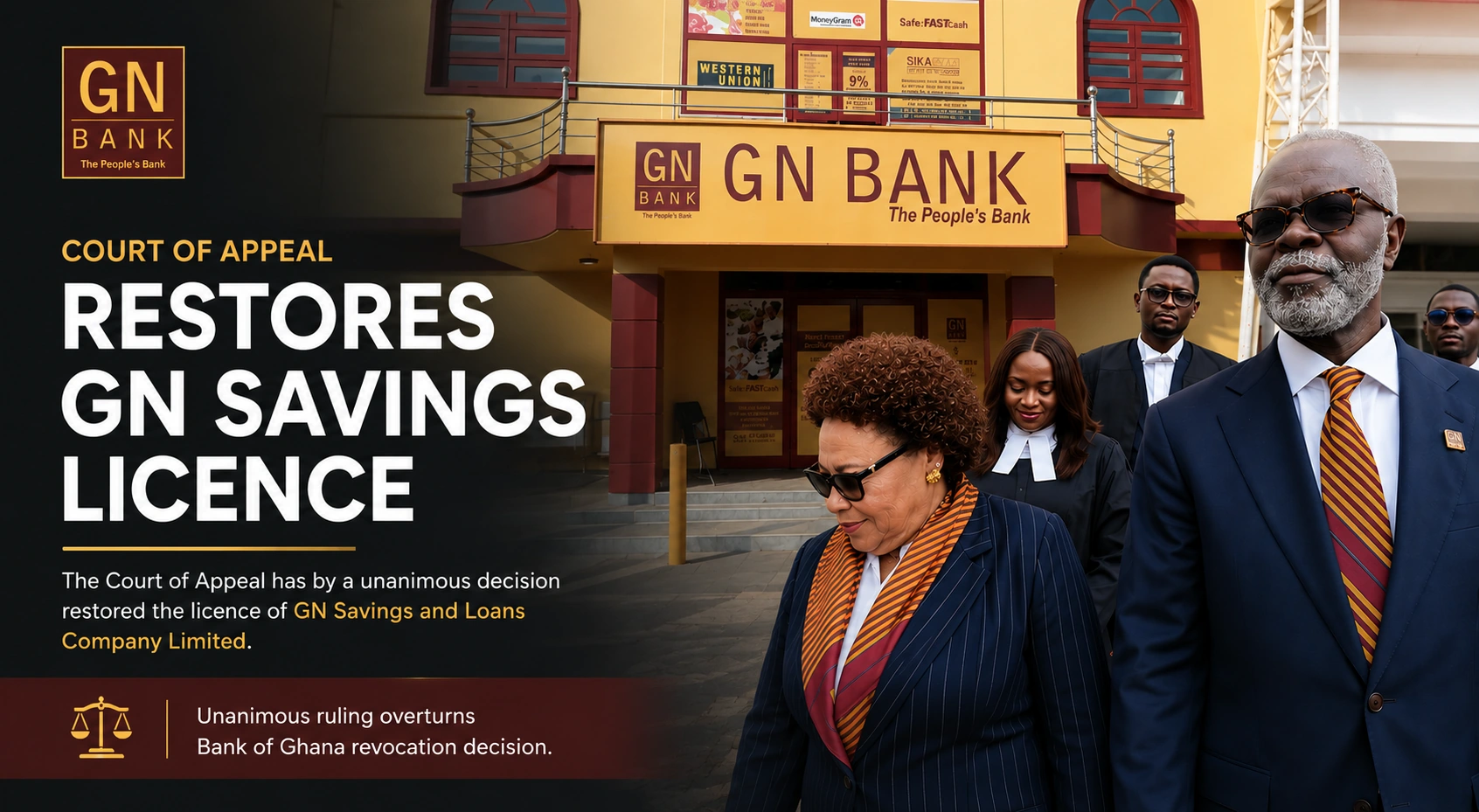
Ghana’s Court of Appeal has overturned the revocation of GN Savings and Loans Company Limited’s operating licence in a ruling that could revive debate over the Bank of Ghana’s controversial banking sector clean-up programme.
A three-member panel of the appellate court unanimously quashed an earlier High Court decision that upheld the revocation of the institution’s licence, ruling that the regulatory action against GN Savings and Loans was “unfair and unreasonable”. The court also directed the receiver, Eric Nana Nipah, to hand over possession, management and control of the company’s assets and operations to shareholders of the institution. The decision marks a significant legal reversal in one of the most closely watched disputes linked to Ghana’s financial sector reforms, which led to the collapse, merger or revocation of licences of several financial institutions beginning in 2017.
GN Savings’ licence revocation challenged years after banking clean-up
GN Savings and Loans was formerly GN Bank before being reclassified as a savings and loans institution on 4 January 2019 during a wider restructuring exercise led by the Bank of Ghana. Seven months later, the central bank, under then-Governor Dr Ernest Addison, revoked the company’s operating licence and appointed Eric Nana Nipah as receiver as part of the banking sector clean-up initiative.
The owners of the institution, led by businessman and former presidential candidate Dr Papa Kwesi Nduom, challenged the decision in the High Court in Accra later that year, arguing that the revocation breached existing laws and regulatory procedures. In January 2024, the High Court, presided over by Justice Gifty Adjei Addo, ruled in favour of the Bank of Ghana and upheld the revocation.
The High Court concluded that governance deficiencies and capital challenges had rendered the institution incapable of meeting regulatory obligations at the time its licence was revoked. However, the Court of Appeal has now overturned both the revocation and the earlier High Court judgement.
Lawyers representing GN Savings and Loans said the appellate ruling effectively restores the institution’s operating status and requires the receiver to return management control to shareholders. It was not immediately clear whether the Bank of Ghana would seek to challenge the ruling at the Supreme Court.
Banking sector ruling raises regulatory and financial questions
The judgement is expected to intensify public debate over Ghana’s banking sector cleanup, which authorities said was necessary to stabilise the financial system after years of weak supervision, liquidity pressures and governance failures across parts of the sector. The clean-up exercise resulted in the collapse or restructuring of several banks, savings and loans firms and microfinance institutions, affecting thousands of customers and workers nationwide.
Supporters of the reforms argued that stronger regulatory intervention was needed to protect depositors and restore confidence in Ghana’s financial system. Critics, however, have long questioned whether some institutions were treated fairly during the process and whether all regulatory actions were proportionate.
Financial analyst Courage. Martey said the latest ruling could have broader implications for confidence in regulatory decisions. “When an appellate court overturns a major regulatory action years after implementation, it naturally raises questions about due process, institutional accountability and the long-term consequences for affected businesses,” he said. He added that the case could encourage renewed scrutiny of other disputes linked to the banking cleanup era.
Banking lawyer Ama Baah said the ruling did not necessarily mean the institution could immediately resume full operations without satisfying regulatory conditions imposed under Ghana’s banking laws.
“A court can restore a licence decision, but operational banking activity still depends on compliance with prudential and capital requirements,” she said. She added that the central bank could still pursue further legal or regulatory action depending on the full written judgement.
Customers and former workers await clarity
The ruling has generated renewed attention among former customers, shareholders and workers linked to GN Savings and Loans, many of whom have spent years seeking clarity over the future of the institution and its assets. Some former depositors said they hoped the judgement could accelerate resolution processes linked to frozen operations and outstanding financial obligations.
Others cautioned that the legal ruling alone might not immediately restore full banking services or compensate affected customers. At the time of publication, the Bank of Ghana had not publicly responded to the Court of Appeal decision or indicated whether it intended to challenge the ruling further.
The central bank previously defended the licence revocation as lawful and consistent with efforts to strengthen financial sector stability during the cleanup programme. Economists say the latest judgement could become an important legal reference point in future disputes involving financial regulation, receivership powers and administrative fairness in Ghana’s banking sector. The Court of Appeal’s full written judgement is expected to provide further detail on the legal basis for overturning the revocation and the extent of the obligations placed on regulators and the receiver.
Related posts:
 IMF PCI to Strengthen Bank of Ghana’s Balance Sheet
  Ghana’s Debt Climbs to GH₵674bn Despite IMF Recovery Gains
  Ghana Nears First Non-Interest Banking Licence as BoG Warns on Fintech Trust
  Bank of Ghana suspends proposed 0.75% mobile money transfer fee
  MTN Ghana to Start Charging Customers for MoMo-to-Bank Transfers From June 1