
Nigeria investigates mysterious white foam found along busy Kaduna-Abuja highway
Nigeria's environmental regulator is investigating mysterious white foam found along the Kaduna-Abuja Expressway after a suspected lorry spill. Laboratory tests are under way as officials urge the public to stay away.

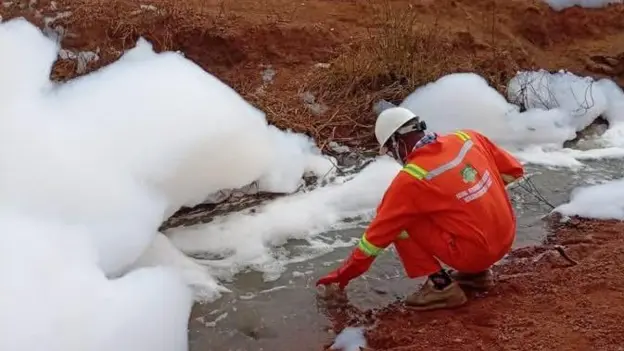

Nigeria’s environmental regulator is investigating the appearance of an unidentified white foamy substance along the Kaduna-Abuja Expressway after preliminary evidence suggested it may have originated from a road accident involving a lorry. Authorities have urged the public to avoid contact with the material while laboratory tests determine whether it poses any environmental or public health risks.
ABUJA, Nigeria — Nigerian environmental authorities have launched an investigation after an unidentified white foamy substance appeared beside the Kaduna-Abuja Expressway, prompting public safety warnings while laboratory tests seek to determine whether the material poses environmental or health risks.
The National Environmental Standards and Regulations Enforcement Agency (NESREA), Nigeria’s federal regulator responsible for enforcing environmental standards, pollution control and hazardous waste regulations, said inspectors had collected samples of the substance together with nearby soil and stream water for scientific analysis.
Officials have advised motorists, residents and curious onlookers not to touch the foam or enter the affected area until laboratory testing has established its composition and any associated risks. The discovery attracted widespread attention after photographs and videos circulated across social media, with motorists stopping along the highway to observe and photograph the unusual white substance, which many compared to snow.
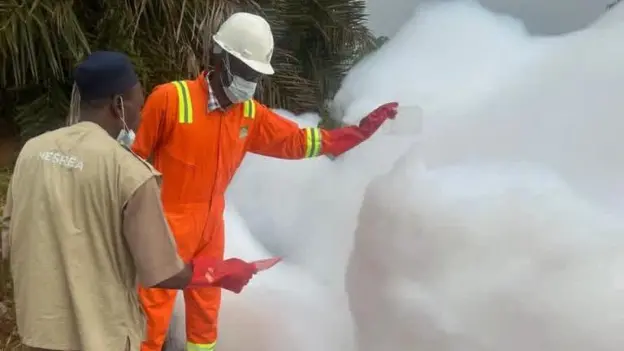
Investigation focuses on possible lorry spill.
According to NESREA, preliminary findings indicate the material may have originated from a road accident involving a lorry travelling along the expressway. However, officials stressed that investigators have not yet identified the substance or confirmed what the vehicle was transporting. They cautioned against speculation until laboratory testing is complete. Authorities have not reported injuries linked to the incident. The agency said its investigation remains ongoing.
Scientists begin laboratory analysis
Environmental officers collected multiple samples from the scene, including:
- the white foamy material
- surrounding soil
- nearby stream water
The samples are expected to undergo laboratory testing to determine:
- the chemical composition of the substance
- whether hazardous compounds are present
- any contamination of surrounding soil or waterways
- potential risks to humans, wildlife and the environment.
NESREA has not indicated when results are expected to be released.
Why authorities are urging caution
Although there is no evidence at present that the substance is dangerous, environmental specialists generally advise against direct contact with unidentified industrial materials.
Depending on their composition, some substances can cause:
- skin or eye irritation
- contamination of groundwater
- damage to aquatic ecosystems
- pollution of agricultural land
- risks to livestock and wildlife.
Officials said the precautionary advice reflects standard environmental response procedures while investigators establish exactly what the substance is.
What can cause white industrial foam?
Environmental scientists note that appearance alone cannot determine whether a substance is hazardous.
Dense white foam may originate from several sources, including:
- industrial detergents or surfactants
- firefighting foam concentrates
- certain manufacturing chemicals
- food-processing waste
- fermentation by-products
- chemical cargo released during transport accidents.
Some foams pose little environmental risk, while others may contain substances requiring specialised clean-up operations. Only laboratory analysis can determine the level of danger.
Public curiosity fuels speculation
The unusual sight quickly became a roadside attraction, with numerous motorists reportedly stopping to photograph the scene. Videos shared online showed people gathering near the affected area, while social media users offered competing theories about its origin.
Some described the substance as resembling snow—an uncommon sight in tropical West Africa—while others speculated that it resulted from a chemical spill. Authorities have urged the public to rely on official information rather than unverified online claims.
Why this matters beyond Nigeria
Environmental incidents involving unidentified industrial substances are becoming an increasing concern across Africa as road freight transport expands alongside manufacturing, mining and energy industries. Major highways carry large volumes of industrial chemicals, petroleum products and other potentially hazardous materials every day. When accidents occur, rapid environmental assessment is essential to determine whether nearby communities, rivers or farmland have been contaminated. Environmental regulators increasingly emphasise the importance of early detection, scientific testing and transparent public communication to minimise health risks and prevent misinformation.
The significance of the Kaduna-Abuja Expressway
The Kaduna-Abuja Expressway is among Nigeria’s busiest transport corridors, linking the federal capital with northern commercial centres. Thousands of passenger vehicles, freight lorries and commercial operators use the route daily, making it strategically important for trade and national logistics. Any environmental incident along the highway has the potential to affect transport, nearby communities and local ecosystems if hazardous materials are involved.
Possible Legal Implications
Any legal consequences will depend on what laboratory testing establishes about the substance, its origin and the circumstances in which it reached the roadside.
Should scientific analysis determine that the material originated from improperly transported industrial chemicals or hazardous waste, authorities could investigate whether environmental, transport or hazardous-materials regulations were breached.
Investigators would also need to establish who owned, transported or handled the substance and whether any person or organisation failed to meet applicable safety obligations.
Potential enforcement measures
Compliance investigation
Regulators could examine whether environmental permits, transport rules or handling requirements were breached.
Clean-up or remediation order
A responsible party could be required to remove the substance and restore any contaminated land or water.
Financial penalties
Administrative or statutory fines may be considered where non-compliance is established.
Criminal proceedings
Criminal action may follow if unlawful handling, serious negligence or deliberate disposal is proven.
Timeline
- 01Day 1
White foamy substance reported
The unidentified material is discovered beside the Kaduna–Abuja Expressway.
- 02Shortly afterwards
Images circulate online
Photographs and video of the unusual foam spread widely on social media, prompting public concern and speculation.
- 03Same day
Environmental inspectors deployed
Nigeria’s National Environmental Standards and Regulations Enforcement Agency sends officials to assess the site.
- 04Investigation begins
Foam, soil and water samples collected
Samples are taken to establish the material’s chemical composition and assess possible contamination.
- 05Current stage
Laboratory analysis under way
Scientists are expected to determine the identity, origin and potential health or environmental effects of the material.
- 06Next step
Findings and official action expected
Authorities are expected to publish the test results and determine whether clean-up, enforcement or further investigation is required.
What Happens Next?
The investigation will move from precautionary site management to evidence-based decisions once the laboratory results are available.
Environmental authorities are expected to complete five principal tasks.
- 01
Identify the substance through laboratory testing.
- 02
Determine whether it poses any public-health risk.
- 03
Assess possible contamination of soil, water or nearby ecosystems.
- 04
Establish where the material originated and how it reached the site.
- 05
Decide whether remediation, penalties or legal proceedings are justified.
Why This Story Matters
The incident demonstrates why rapid scientific investigation is essential when an unidentified substance appears in a public place.
Industrial activity, freight transport and the movement of chemicals continue to expand across Africa. Effective environmental emergency systems must therefore be able to secure affected sites, obtain samples, identify hazards and communicate clearly with nearby communities.
Transparent public information is equally important. In the absence of verified evidence, dramatic images can encourage rumours, exaggerated health claims or false explanations that undermine confidence in the official response.
Key Takeaways
- 01
Nigeria is investigating an unidentified white foamy substance found beside the Kaduna–Abuja Expressway.
- 02
Preliminary information suggests that it may be connected to a lorry involved in a road accident.
- 03
Foam, soil and water samples have been collected for scientific analysis.
- 04
Authorities have advised the public not to touch or approach the material.
- 05
Officials have not confirmed that the substance presents a health or environmental risk.
- 06
Laboratory findings may determine whether environmental regulations were breached or remediation is required.
Frequently Asked Questions
What is the white foam?
Authorities have not yet identified it. Laboratory testing of the material and environmental samples is under way.
Is the substance dangerous?
There is currently no confirmed evidence that it is hazardous. Officials are nevertheless advising people to avoid contact until scientific testing has been completed.
Where was it found?
It was reported beside the Kaduna–Abuja Expressway in Nigeria.
Who is investigating?
Nigeria’s National Environmental Standards and Regulations Enforcement Agency, commonly known as NESREA, is leading the environmental investigation.
Could the substance have come from a lorry?
Preliminary information suggests a possible connection to a lorry involved in an accident, but the precise origin has not yet been scientifically confirmed.
What happens after laboratory testing?
Authorities will assess the substance’s composition, possible health and environmental risks, likely origin and whether clean-up or enforcement action is required.
Related posts:
 Nigeria Arrests Former Power Minister After 75-Year Corruption Sentence
  Four Sentenced to Death Over Nigeria’s Deadly Owo Church Attack
  Can the $25bn Nigeria–Morocco Gas Pipeline Deliver?
  South Africa anti-migrant protests: Thousands flee as Ramaphosa calls for calm ahead of unofficial deadline
  Nigeria seeks compensation from South Africa over migrant property losses