Mahama Courts Investors at London Stock Exchange as Ghana Seeks Fresh Capital


Follow Nukunya
Get the latest breaking news and updates from Nukunya.
President John Mahama used a high-profile appearance at the London Stock Exchange to promote Ghana as an investment destination, highlighting stock market performance, economic reforms and new public listings. The event formed part of a broader effort to attract foreign capital as Ghana seeks to strengthen economic recovery and accelerate growth.
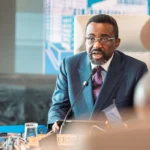
LONDON, United Kingdom — President John Dramani Mahama has used a visit to the London Stock Exchange (LSE) to encourage international investors to consider opportunities in Ghana, presenting the country’s economic recovery, capital market performance and investment prospects to a global audience of financiers and business leaders.
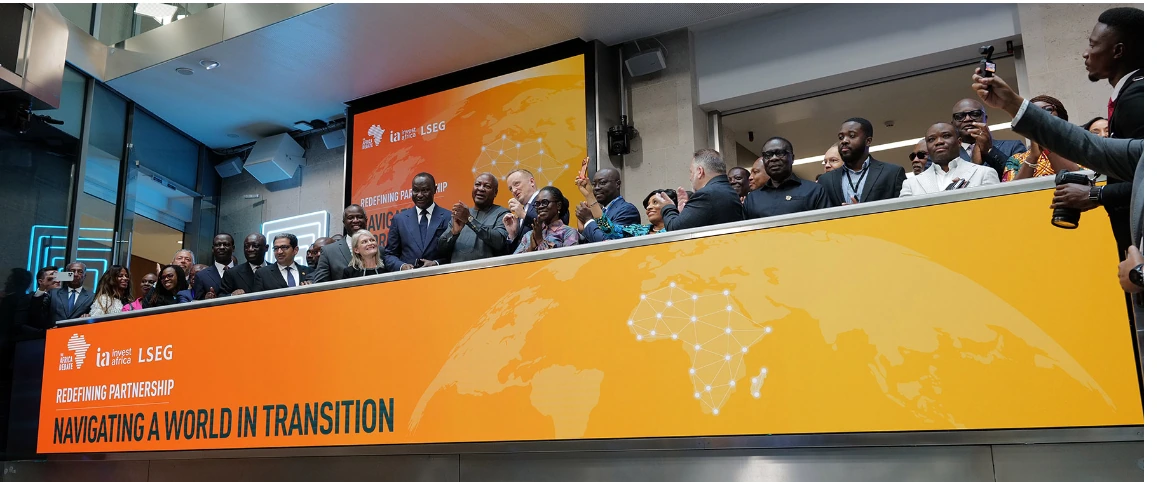
Mahama officially opened trading at the London Stock Exchange on Wednesday by ringing the market’s opening bell at Paternoster Square, one of the world’s most recognised financial centres. The ceremony formed part of his five-day visit to the United Kingdom and coincided with The Africa Debate 2026, a major investment forum that brought together more than 500 policymakers, investors, development institutions and corporate executives to discuss Africa’s economic future.
The event provided Ghana with a prominent platform to compete for international capital at a time when African economies are increasingly seeking investment to support growth, industrialisation and job creation.
Making Ghana’s Investment Case
Addressing investors, Mahama argued that Ghana’s economic fundamentals have improved significantly over the past 18 months, citing lower inflation, a more stable cedi and stronger foreign exchange reserves as evidence of renewed confidence in the economy.
He also highlighted the performance of the Ghana Stock Exchange (GSE), pointing to market data that showed the GSE Composite Index had returned more than 63 per cent earlier this year, placing it among the world’s strongest-performing equity markets.
“In a world searching for yield in a global environment of uncertainty and elevated risk premia, Ghana’s equity market has delivered returns that rival and, in many cases, surpass the world’s most developed exchanges,” Mahama told investors. The President said Ghana was positioning itself as a gateway for investment into Africa and encouraged international investors to look beyond traditional markets for growth opportunities.
A Market Showing Signs of Recovery
Mahama used the London platform to showcase what he described as a revival in Ghana’s capital markets after several years of subdued activity.
He cited three recent or planned public offerings, including First Atlantic Bank, Zen Petroleum and Kasapreko, as evidence that investor confidence was returning to the market. According to the President, the transactions collectively raised billions of cedis and reflected renewed interest from both businesses and investors.
“Three IPOs, three oversubscriptions, three sectors. This is not a coincidence. This is confidence,” he said.
The Ghana Stock Exchange currently comprises both equity and fixed-income markets, providing businesses and investors with access to a range of financing and investment opportunities.
Why London Matters
Mahama’s choice of venue was significant.
The United Kingdom remains one of Ghana’s most important economic partners, with longstanding links in trade, finance, investment and development cooperation.
London is home to many institutional investors, investment funds and multinational companies that play an influential role in directing capital flows into emerging and frontier markets.
By addressing investors at the London Stock Exchange, Ghana’s government was seeking direct engagement with decision-makers capable of investing in Ghanaian businesses, infrastructure and capital markets.
The Africa Debate 2026
Beyond the opening bell ceremony, Mahama’s appearance coincided with The Africa Debate 2026, one of the continent’s leading investment and policy forums. The conference brought together senior government officials, development finance institutions, private-sector leaders and international investors to discuss trade, infrastructure, energy, technology and economic transformation across Africa.
For Ghana, participation provided an opportunity not only to promote investment opportunities but also to position itself within broader conversations about Africa’s economic future.
A Positive Story, But Challenges Remain
While Mahama presented an optimistic assessment of Ghana’s economy, challenges remain.
Ghana continues to implement reforms under its International Monetary Fund-supported programme while working to sustain fiscal discipline, manage public debt and maintain investor confidence.
Businesses also continue to face challenges, including financing costs, infrastructure gaps and broader global economic uncertainty. However, market analysts have noted improving investor sentiment toward Ghana in recent months as macroeconomic conditions stabilise and reforms begin to take effect.
The government’s argument is that maintaining policy consistency and economic discipline will be essential if recent gains are to translate into sustained investment and growth.
What This Means for Ghana
For many Ghanaians, stock exchanges and investment forums can seem distant from everyday life.
Yet access to capital remains one of the biggest obstacles facing many Ghanaian businesses. A stronger and more active capital market can provide companies with alternatives to expensive bank borrowing, enabling expansion, innovation and job creation.
If investor interest generated through events such as the London Stock Exchange engagement translates into new investment, the benefits could extend beyond financial markets through increased business activity, employment opportunities and higher government revenues.
That is where the real significance of the London visit lies. The success of the mission will ultimately be measured not by speeches, ceremonies or market openings, but by whether investment decisions made in London help create opportunities in Accra, Kumasi, Takoradi and communities across Ghana.
What Happens Next?
Attention will now turn to whether the momentum highlighted by Mahama results in additional foreign investment, new stock market listings and increased participation in Ghana’s capital markets.
Investors will also closely watch upcoming listings, including Kasapreko PLC, as indicators of confidence in Ghana’s economic outlook. For Ghana, the challenge is no longer simply attracting attention. It is converting international interest into long-term investment that delivers tangible economic benefits.
Related posts:
 PBC Workers Renew Appeal to Mahama as Salary Arrears Reach 27 Months, Union Says
  Ghana’s Debt Climbs to GH₵674bn Despite IMF Recovery Gains
  Ghana Nears First Non-Interest Banking Licence as BoG Warns on Fintech Trust
  Ghana Maintains Cocoa Producer Price Despite Global Market Slump: What It Means for Farmers and the Economy
  GhIPSS returns GH¢14.58m dividend to Bank of Ghana after profitable year