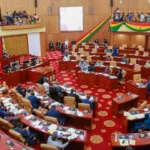

GhIPSS returns GH¢14.58m dividend to Bank of Ghana after profitable year


Follow Nukunya
Get the latest breaking news and updates from Nukunya.
Ghana Interbank Payment and Settlement Systems (GhIPSS) has presented a GH¢14.58 million dividend to the Bank of Ghana following a profitable 2025 financial year, with the central bank praising the company for strengthening the country’s digital payments infrastructure.
ACCRA, Ghana — Ghana Interbank Payment and Settlement Systems (GhIPSS) has presented a GH¢14.58 million dividend to the Bank of Ghana after recording a profitable 2025 financial year, underscoring the growing importance of the country’s digital payments infrastructure to the financial sector and wider economy.
The dividend was formally presented on 1 July during a ceremony at Bank Square following the successful conclusion of GhIPSS’ Annual General Meeting. As the company’s sole shareholder, the Bank of Ghana receives the dividend as part of GhIPSS’ financial returns for the year.
Receiving the payment, Bank of Ghana Governor Dr Johnson Asiama described the occasion as an important governance milestone that reflected both the company’s financial performance and its commitment to transparency and accountability.
“This ceremony marks an important governance milestone, providing the opportunity for GhIPSS to formally present its approved dividend to its sole shareholder,” Dr Asiama said.
He congratulated the GhIPSS Board, management and staff for what he described as another successful year, praising the institution’s efforts to strengthen Ghana’s national payments infrastructure while supporting the country’s expanding digital financial ecosystem.
“As shareholder, we appreciate not only the financial return presented today but also the value GhIPSS continues to create through the development of secure, resilient and interoperable payment infrastructure that supports Ghana’s financial sector and the broader economy,” he added.
The Governor also encouraged the company to sustain its operational performance, continue investing in innovation and pursue strategic initiatives capable of supporting long-term growth.
Why the dividend matters
While the dividend represents a financial return to the Bank of Ghana, it also reflects the commercial performance of one of Ghana’s most important financial infrastructure institutions.
Unlike commercial banks, GhIPSS operates the national payment rails that enable many electronic transactions carried out every day across the country. Its infrastructure supports secure and interoperable payment services between banks, mobile money providers and other financial institutions, helping consumers and businesses transfer money more efficiently.
A profitable GhIPSS therefore signals more than a successful corporate year. It demonstrates the continued operation and development of the systems that underpin Ghana’s increasingly digital economy.
Backbone of Ghana’s digital payments
GhIPSS plays a central role in Ghana’s financial system by providing the infrastructure that allows different payment platforms to communicate securely with one another.
Its services support electronic fund transfers, cheque processing, payment switching and interoperability across the banking and mobile money sectors. These capabilities have become increasingly important as digital transactions continue to replace cash for everyday payments, commerce and government services.
The company’s mandate extends beyond profitability. By maintaining secure and resilient payment infrastructure, GhIPSS helps reduce settlement risks, improve transaction efficiency and strengthen confidence in Ghana’s financial system.
Supporting Ghana’s digital economy
The dividend presentation comes as Ghana continues to expand the use of digital financial services across both the public and private sectors.
Government agencies, financial institutions and payment service providers increasingly rely on interoperable payment systems to process salaries, taxes, business transactions and retail payments. As transaction volumes grow, the resilience and efficiency of the underlying infrastructure become increasingly important for economic activity.
Industry analysts view continued investment in payment infrastructure as essential to supporting financial inclusion, reducing transaction costs and encouraging innovation within Ghana’s rapidly evolving fintech sector.
Governance and accountability
Dr Asiama said the dividend presentation also demonstrated sound corporate governance by ensuring the company’s financial performance was transparently reported to its shareholder. The payment followed approval of GhIPSS’ 2025 financial statements at its Annual General Meeting and reflects the company’s operational and financial performance during the year.
For public institutions, regular dividend payments can provide evidence of prudent financial management while reinforcing accountability to shareholders and the wider public.
Why this matters
Although dividend announcements rarely attract widespread public attention, GhIPSS occupies a unique position within Ghana’s financial architecture. Every mobile money transfer, bank-to-bank payment and many electronic transactions depend on secure national payment infrastructure operating reliably behind the scenes. Continued investment in that infrastructure supports confidence in digital payments, encourages innovation and contributes to broader economic modernisation. As Ghana continues its transition towards a more digitally connected economy, the performance of institutions such as GhIPSS will remain central to the resilience and efficiency of the country’s financial system.
Key Facts
Dividend GH¢14.58 million
Financial year 2025
Shareholder Bank of Ghana
Presented 1 July 2026
Recipient BoG Governor Dr Johnson Asiama
Institution Ghana Interbank Payment and Settlement Systems
What this means
The dividend highlights both GhIPSS’ financial performance and its strategic importance to Ghana’s digital economy. As electronic transactions continue to expand, maintaining secure and interoperable payment infrastructure will remain critical to financial stability, business confidence and economic growth.

Related posts:
 Ghana Nears First Non-Interest Banking Licence as BoG Warns on Fintech Trust
  MTN Ghana to Start Charging Customers for MoMo-to-Bank Transfers From June 1
  IMF PCI to Strengthen Bank of Ghana’s Balance Sheet
  Ghana’s Debt Climbs to GH₵674bn Despite IMF Recovery Gains
  Bank of Ghana suspends proposed 0.75% mobile money transfer fee