Reparatory Justice Explained: Meaning, Law and Africa’s Case


Follow Nukunya
Get the latest breaking news and updates from Nukunya.
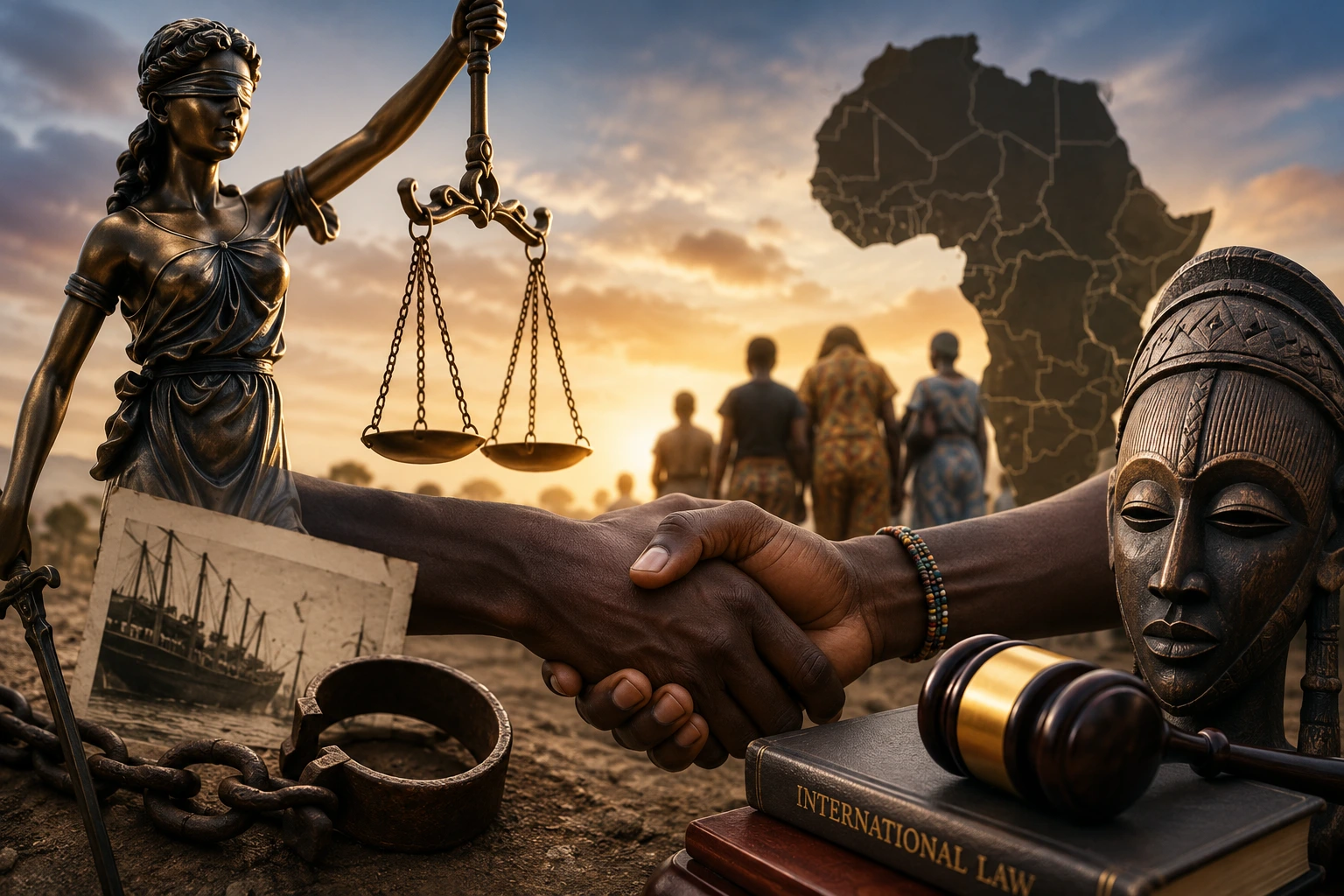
Reparatory justice seeks more than financial compensation. It addresses the continuing effects of slavery, colonialism and racial discrimination through restitution, reform, acknowledgement and guarantees against repetition.
Reparatory justice has moved from the margins of political debate into African, Caribbean and international diplomacy. It asks how states, institutions and societies should address the continuing consequences of enslavement, colonial rule, racial discrimination, dispossession and the extraction of wealth from African peoples.
The term is often reduced to demands for cash payments. Its meaning is wider. Reparatory justice may include acknowledgement, formal apology, compensation, restitution of land or cultural objects, debt measures, institutional reform, investment in health and education, historical research and guarantees that comparable abuses will not recur.
Africa’s campaign gained significant institutional backing when the African Union designated 2025 as the year of “Justice for Africans and People of African Descent Through Reparations”. The decision followed a proposal arising from the 2023 Accra Reparations Conference and placed the issue on the continental policy agenda.
The initiative has since developed beyond a single annual theme. African Union officials said in March 2026 that the organisation had endorsed a longer programme extending the campaign into a continental decade, intended to institutionalise work on reparations and racial justice.
What is reparatory justice?
Reparatory justice is a process through which those responsible for, enriched by or institutionally connected to serious injustice seek to repair the resulting harm.
It differs from ordinary development assistance. Aid is generally presented as discretionary support given in response to need. A reparation is grounded in responsibility for a wrongful act and the rights of those who suffered harm.
The United Nations framework on remedy and reparation identifies several established forms of redress:
- Restitution, aimed at restoring a person or community to the position that existed before the violation where possible.
- Compensation, covering economically assessable harm.
- Rehabilitation, including medical, psychological, legal and social support.
- Satisfaction, which may include truth-seeking, acknowledgement, apology, memorialisation and recovery of remains.
- Guarantees of non-repetition, involving legal, educational and institutional reforms intended to prevent recurrence.
These categories appear in the UN Basic Principles and Guidelines on the Right to a Remedy and Reparation, adopted by the General Assembly in 2005. The principles primarily address victims of gross violations of international human rights law and serious violations of humanitarian law. They provide an important framework, but do not automatically resolve legal claims involving events that occurred centuries ago.
Reparatory justice therefore combines legal argument, historical evidence, political negotiation and moral responsibility. The form it takes depends on the harm, the affected population, the institution involved and the remedy considered practicable.
How reparatory justice differs from reparations
“Reparations” commonly describes the remedies provided after wrongdoing. “Reparatory justice” describes the broader process through which the harm is acknowledged, assessed and addressed.
A payment can be a reparation, but money alone may not constitute reparatory justice. A government could offer compensation without disclosing historical records, changing discriminatory structures or consulting affected communities. Such an arrangement might settle a narrow financial claim without addressing the wider damage.
Conversely, restitution of cultural objects, an official apology or a scholarship programme may form part of a reparatory package even when no direct payment is made to individuals. Advocates consequently describe reparatory justice as both backward-looking and forward-looking. It examines how the harm was created, while seeking changes that improve the rights, capacity and security of affected communities today.
Why the debate concerns present-day conditions
The central case for African reparations is not simply that grave abuses occurred. That fact is extensively documented. The argument is that systems built through enslavement, colonial extraction and racial hierarchy produced consequences that did not disappear when slavery was abolished or colonies gained independence.
The transatlantic system forcibly transported millions of Africans over several centuries. Enslaved labour generated agricultural commodities, tax receipts, shipping income, insurance activity and industrial investment across the Atlantic economy.
Colonial governments later imposed political control, extracted natural resources, reorganised land ownership and directed African economies towards the needs of imperial markets. The effects varied significantly between territories, and African societies were not passive or uniform. Resistance, negotiation and local agency formed an important part of the history.
UNESCO’s Routes of Enslaved Peoples programme supports research, education and preservation connected to slavery and the slave trade. The programme treats memory as part of the response to contemporary racism and the historical silences surrounding enslavement.
Advocates argue that reparatory justice should examine the cumulative effects of these systems on wealth, public institutions, cultural identity, borders, education, health and development.
Critics respond that present-day inequality has many causes, including domestic governance, conflict, economic policy and decisions made after independence. That objection does not necessarily disprove the historical case, but it challenges claims that colonialism alone explains current outcomes.
A credible assessment must hold both propositions together: historical exploitation shaped later opportunities, while present conditions also reflect policies and events that followed.
Africa’s reparatory justice campaign
The African Union has made reparations a formal continental priority rather than leaving the subject solely to individual governments or campaign organisations.
The 2023 Accra Proclamation emerged from a conference involving participants from Africa, the Caribbean, Latin America, North America and Europe. It called for a united African and diaspora approach to the legacies of enslavement, colonialism, apartheid and racial discrimination.
The proclamation helped shape the AU’s 2025 theme. The continental programme linked reparatory justice to racial healing, development, cultural restoration, institutional reform and collaboration with people of African descent outside the continent.
The African Commission on Human and Peoples’ Rights has also treated reparations as a human-rights issue. Its resolutions have called for coherent standards, institutional structures and sustained implementation under the African Charter on Human and Peoples’ Rights.
The programme matters because it gives African states a common platform. Individual countries may have limited bargaining power when dealing with former colonial powers, museums, universities, churches or multinational institutions. A coordinated position can establish shared evidence standards and negotiating principles.
However, unity should not erase differences. Enslavement, colonial administration and post-independence experiences were not identical across Africa. Any framework must allow countries and communities to define their own harms and priorities.
Ghana’s role in the reparations movement
Ghana occupies a distinctive place in the debate because of its historical sites, Pan-African tradition and recent diplomatic work.
Cape Coast Castle and Elmina Castle are among the best-known sites associated with the Atlantic trafficking of enslaved Africans. They serve as places of remembrance, education and return for people across the African diaspora.
Ghana has also used cultural initiatives to strengthen relations with descendants of Africans dispersed through slavery. The Year of Return in 2019 and the continuing Beyond the Return programme encouraged visits, citizenship connections, investment and cultural exchange.
These projects are not reparations in themselves. Tourism and diaspora engagement cannot replace accountability for historical injustice. They nevertheless show how memory, reconnection and economic participation can form part of a wider reparatory process.
Ghana’s diplomatic contribution became more significant through the Accra Reparations Conference. The resulting proclamation described the reparations and healing project as multigenerational and transnational, requiring the participation of governments, civil society, communities and the private sector.
In 2026, Ghana continued to support efforts at the United Nations and within the African Union to advance recognition of the trafficking and racialised enslavement of Africans. These developments have strengthened Ghana’s position as a bridge between continental Africa and diaspora-led reparations movements.
For Ghanaian citizens, the key question is whether diplomacy will produce measurable outcomes. These could include stronger heritage protection, research funding, museum cooperation, education, health investment, cultural restitution and economic partnerships based on negotiated responsibility rather than charity.
The Caribbean model
The Caribbean Community has developed one of the most detailed governmental frameworks for reparatory justice.
CARICOM established its Reparations Commission in 2013. Its Ten-Point Plan was adopted as a basis for engagement with European governments and institutions.
The original framework called for:
- a full formal apology;
- support for repatriation;
- an indigenous peoples’ development programme;
- cultural institutions;
- measures addressing public-health harms;
- action against illiteracy;
- an African knowledge programme;
- psychological rehabilitation;
- technology transfer; and
- debt cancellation.
The plan demonstrates why reparatory justice is broader than individual cheques. CARICOM frames historical injustice as a contributor to structural weaknesses in health, education, culture, technology and public finance.
In July 2026, CARICOM heads of government approved a revised reparations manifesto. The update reflected changing international conditions and newer historical and scientific evidence, while retaining a comprehensive approach to repair.
The Caribbean experience offers practical lessons for Africa. It shows the value of a negotiated programme with defined demands, regional coordination and an institution responsible for advancing the work.
It also illustrates the difficulties. European governments have generally resisted accepting broad legal liability for colonial-era enslavement, and formal negotiations have progressed slowly.
Is there a legal right to reparations for slavery and colonialism?
International law recognises a general principle that a breach of an obligation can require reparation. Modern human rights law also protects access to effective remedies for serious violations.
The harder question is whether present-day states can be held legally responsible for conduct that occurred before relevant treaties and modern rules entered into force.
Several obstacles arise:
- the principle that law is generally not applied retrospectively;
- uncertainty over which modern state inherits responsibility;
- difficulty identifying legally entitled claimants;
- changes in borders and governments;
- the participation of state and non-state actors across different regions;
- limitation rules and jurisdictional barriers;
- disagreement over how present harm should be linked to historic conduct.
These difficulties do not make every claim impossible. Claims connected to more recent colonial violence, identifiable property, documented institutional enrichment or continuing legal wrongs may differ substantially from claims concerning events several centuries old.
The United Kingdom set out a restrictive legal position at the United Nations in March 2026. It accepted that slavery and the slave trade are now prohibited under treaty and customary international law, but argued that present legal principles could not simply be applied retrospectively through the concept of continuing harm.
That position reflects one of the strongest objections raised by former colonial powers. It distinguishes acknowledgement of the historical wrong from acceptance of current legal liability.
Reparations advocates contest such a narrow approach. They argue that the effects of dispossession, racial hierarchy and unjust enrichment continued long after formal abolition and independence. They also maintain that political negotiation does not depend entirely on winning a retrospective claim in court.
Reparatory justice can therefore proceed through diplomacy, legislation, institutional agreements and voluntary settlements, even where litigation is uncertain.
What forms could reparatory justice take?
There is no single formula suitable for every country or institution. A credible programme would begin by identifying the specific harm, responsible actors, affected communities and desired outcomes.
Formal acknowledgement and apology
An apology can recognise responsibility, correct the historical record and restore dignity. Its value depends on clarity.
A statement expressing regret without naming the wrongdoing or accepting responsibility may be viewed as insufficient. An effective apology normally identifies the act, recognises the victims, accepts responsibility and indicates steps towards repair.
Financial compensation
Compensation may be paid to individuals, communities, public funds or institutions. It can address property loss, unpaid labour, death, injury or measurable economic damage.
For historic mass injustice, calculating an amount is difficult. Estimates may vary according to the period assessed, the economic model used and whether calculations include accumulated gains, lost opportunities or present inequality.
Any figure should therefore be treated as a negotiating or research estimate rather than an uncontested bill.
Restitution and cultural return
The return of looted cultural objects is among the most visible forms of reparatory action. Restitution can restore ownership, cultural continuity and control over heritage.
Returns also raise practical questions about provenance research, legal title, conservation, access and the capacity of receiving institutions. These issues should support responsible restitution, not become a permanent excuse for withholding objects.
Debt and development measures
CARICOM has included debt cancellation, technology transfer and public-health programmes in its model. African proposals have similarly connected reparations to structural economic reform. Supporters argue that such measures can address collective and intergenerational harm. Critics warn that development programmes should not be relabelled as reparations without an explicit acknowledgement of responsibility. The distinction matters. A reparatory agreement should specify the harm being addressed, the responsible party and the obligations accepted.
Education and historical memory
Curriculum reform, archives, memorials and research funding can correct distorted or incomplete accounts of slavery and colonialism. This work is not merely symbolic. Historical narratives affect identity, citizenship, institutional trust and responses to contemporary racism.
Institutional reform
Banks, insurers, universities, churches, museums and companies may investigate their historical connections to enslavement or colonial extraction. Possible responses include disclosure of archives, scholarships, community investment, restitution, changes to governance and long-term partnerships with affected institutions. The credibility of such programmes depends on whether affected communities help design them. Institutions should not be allowed to define both the harm and the remedy without external scrutiny.
The strongest arguments against reparatory justice
A rigorous explainer must take objections seriously.
People today did not commit the original crimes.
Critics argue that present generations should not be blamed for acts committed by their ancestors. Advocates answer that reparatory justice generally concerns institutional responsibility, inherited benefit and continuing harm rather than personal guilt. States and organisations can retain assets, obligations and legal identity across generations. The debate is therefore less about blaming individuals and more about whether institutions that endure over time also inherit duties connected to their history.
Responsibility is too widely shared.
European states and businesses drove the Atlantic system, but African rulers, merchants and intermediaries also participated in the capture and sale of people. That history complicates any simple division between innocent and guilty regions. It does not, however, erase differences in scale, coercive power, legal organisation, profits or the racial systems subsequently imposed across the Atlantic world. A credible process should acknowledge all relevant actors without using complexity to avoid examining dominant institutions.
The cost cannot be calculated reliably
The duration and scale of historical exploitation make precise valuation difficult. Different models can generate sharply different figures.
That is a real constraint. It supports transparent methods, independent review and negotiated remedies rather than abandonment of the issue.
Many legal settlements address harm that cannot be restored exactly. The impossibility of perfect calculation does not necessarily mean that no repair is justified.
Aid already addresses development needs.
Some governments argue that overseas development assistance and existing partnerships already support countries affected by colonialism. Advocates reject the equivalence. Aid is commonly controlled by donors, can be reduced unilaterally and does not necessarily accept responsibility. Reparatory justice begins with acknowledgement and negotiated obligation. Existing aid may contribute to practical outcomes, but it becomes reparatory only when the parties explicitly define it as part of an agreed remedy.
Governments may misuse the funds.
There are legitimate concerns about corruption, elite capture and weak public accountability. These risks support transparent institutions, community participation, independent audits and measurable objectives. They do not justify denying affected populations any remedy because their governments may fail. A strong reparatory mechanism should specify who controls resources, how decisions are made and how citizens can track results.
Who should receive reparations?
This is among the most contested questions.
Potential beneficiaries include:
- individual survivors of comparatively recent abuses;
- descendants of enslaved or colonised peoples;
- communities that suffered dispossession;
- indigenous peoples;
- national or regional public institutions;
- cultural and educational bodies;
- diaspora communities; and
- programmes addressing documented structural harm.
Different remedies may require different recipients. An object should usually return to its legitimate owner or community. Individual compensation may suit a clearly identified class of victims. Public-health or education initiatives may be delivered through accountable collective funds.
Eligibility should be based on transparent evidence rather than political favour. Communities affected by the original harm must have a meaningful role in setting priorities.
What reparatory justice is not
Reparatory justice is not a claim that every present-day problem results from colonialism.
It does not require treating Africans or people of African descent only as victims. The history also includes resistance, survival, institution-building, intellectual leadership and cultural creation.
It is not necessarily limited to money, and it should not become an undefined demand without evidence, objectives or accountability.
Nor should it be confused with ordinary diplomatic goodwill. For an initiative to be genuinely reparatory, it should connect an acknowledged harm to an agreed remedy.
What happens next?
The reparations movement is likely to develop through several parallel routes.
The African Union’s longer-term programme creates an opportunity to establish common research standards, negotiating positions and institutions. CARICOM’s revised plan provides a counterpart for Africa-Caribbean cooperation. Museums and universities will face continued pressure to examine provenance, publish archives and return objects acquired through violence or coercion.
Governments may pursue bilateral commissions rather than one global settlement. These could address specific colonial relationships, historic atrocities or categories of property. Legal claims will continue, but political agreements may advance faster than international litigation. Courts demand jurisdiction, admissible evidence and recognised causes of action. Diplomacy permits wider remedies but depends on political will.
The strongest programmes will be those that move beyond declarations. They will define the harm, identify responsible institutions, include affected communities, set measurable obligations and publish progress. Reparatory justice is therefore not a single invoice for history. It is a contested framework for deciding what acknowledgement, responsibility and repair should mean when the institutions and inequalities shaped by grave injustice continue into the present.
Reparatory Justice Timeline
The modern reparations movement draws on centuries of historical harm and a growing body of African, Caribbean and international policy action.
| Period | Development |
|---|---|
| Fifteenth to nineteenth centuries | European-directed Atlantic trafficking enslaves and transports millions of Africans. |
| Nineteenth century | European states gradually abolish slave trading and legal enslavement, often without compensating formerly enslaved people. |
| Late nineteenth to twentieth centuries | Colonial rule expands across most of Africa. |
| The Abuja Proclamation advances a coordinated Pan-African reparations agenda. | |
| The Durban Declaration recognises slavery and the slave trade as crimes against humanity. | |
| CARICOM establishes its Reparations Commission. | |
| CARICOM adopts its Ten-Point Plan as a regional reparations framework. | |
| Ghana launches the Year of Return. | |
| Ghana and the African Union convene the Accra Reparations Conference. | |
| African Union leaders select reparations as the organisation’s theme for 2025. | |
| The African Union launches Justice for Africans and People of African Descent Through Reparations . | |
| The African Union advances a longer continental programme and CARICOM approves a revised reparations manifesto. |
Frequently Asked Questions
Reparatory justice encompasses several forms of remedy and remains the subject of active legal, political and diplomatic debate.
Is reparatory justice only about financial payments?
No. Compensation is one possible remedy. Other measures include apologies, restitution, rehabilitation, historical disclosure, institutional reform, cultural restoration, debt measures and guarantees against repetition.
Is reparatory justice recognised in international law?
International law recognises rights to remedy and reparation for serious violations.
Applying those principles to historic slavery and colonialism raises disputed questions about retroactivity, state responsibility, jurisdiction and the identification of claimants.
Has Britain agreed to pay reparations for slavery?
The United Kingdom has acknowledged the historical wrong of slavery but continues to dispute broad retrospective legal liability.
Its March 2026 statement at the United Nations argued that current international-law rules could not simply be applied to conduct from earlier centuries.
What is CARICOM demanding?
CARICOM’s framework covers:
- formal apology;
- repatriation support;
- Indigenous development;
- cultural institutions;
- public-health measures;
- literacy initiatives;
- African knowledge programmes;
- psychological rehabilitation;
- technology transfer; and
- debt-related measures.
What is Ghana’s role?
Ghana hosted the 2023 Accra Reparations Conference, supports African Union action and provides an important geographic and cultural connection between Africa and the global African diaspora.
Who would receive reparations?
That depends on the nature of the claim and the remedy agreed. Potential recipients could include individuals, descendants, affected communities, institutions, states or regional programmes addressing continuing harm.
Would overseas aid count as reparations?
Not automatically. Aid becomes reparatory only where responsibility is acknowledged and the assistance forms part of a negotiated remedy linked to a defined harm.
What Reparatory Justice Can Include
Reparations may combine financial, institutional, cultural and development-focused remedies rather than rely on a single form of redress.
Restitution
Returning property, cultural objects, land, records or other assets where restoration is possible.
Compensation
Financial redress for economically assessable loss, deprivation or continuing disadvantage.
Rehabilitation
Health, education, psychological, social and community-development measures addressing lasting harm.
Satisfaction
Apologies, truth-telling, memorialisation, historical disclosure and formal acknowledgement.
Institutional Reform
Changes to laws, organisations, education and public policy to address structural legacies.
Guarantees of Non-Repetition
Measures intended to prevent similar injustice and discrimination from recurring.
Key Facts
- 01
Reparatory justice includes compensation but is not limited to financial payments.
- 02
The United Nations recognises restitution, compensation, rehabilitation, satisfaction and guarantees of non-repetition as forms of reparation.
- 03
The African Union made reparations its official theme for 2025.
- 04
The continental initiative arose partly from the 2023 Accra Proclamation.
- 05
CARICOM has maintained a governmental reparations framework since 2014 and approved a revised manifesto in July 2026.
- 06
International-law principles support remedies for serious violations, but their retrospective application to slavery and colonialism remains contested.
- 07
Ghana has become a significant diplomatic and cultural centre in the Africa-diaspora reparations movement.
Strategic significance
Why This Matters
The reparations debate is increasingly moving from historical acknowledgement towards questions of policy design, institutional responsibility and practical remedy.
For African states and diaspora communities, the issue concerns not only recognition of past injustice but also the continuing social, economic, cultural and institutional consequences attributed to slavery and colonial rule.
The movement’s long-term credibility will depend on whether governments can convert broad declarations into clearly defined claims, accountable institutions and remedies supported by credible evidence.
Evidence and transparency
Source Note
This explainer is grounded principally in the African Union’s Accra Proclamation and official reparations programme, the CARICOM Ten-Point Plan, United Nations reparation principles, UNESCO’s Routes of Enslaved Peoples programme and the United Kingdom’s publicly stated legal position.
Related posts:
 ECOWAS backs Ghana’s anti-xenophobia push as West African ministers endorse AU petition and reparatory justice framework
  Ghana Welcomes First Evacuees From South Africa Amid Xenophobia Fears
  Ghana intensifies fight against money laundering amid major corruption investigations in 2026
  Ghana demands justice after citizen killed during South Africa anti-immigration protests
  Africa Shield Explained: Why Security Is Becoming Essential to Africa’s Economic Growth