Ghana’s inflation slows for third straight month, easing pressure on households


Follow Nukunya
Get the latest breaking news and updates from Nukunya.
Ghana’s inflation slowdown has helped stabilise food and transport costs, offering cautious relief after months of price volatility.
ACCRA, Ghana — 4 May 2026
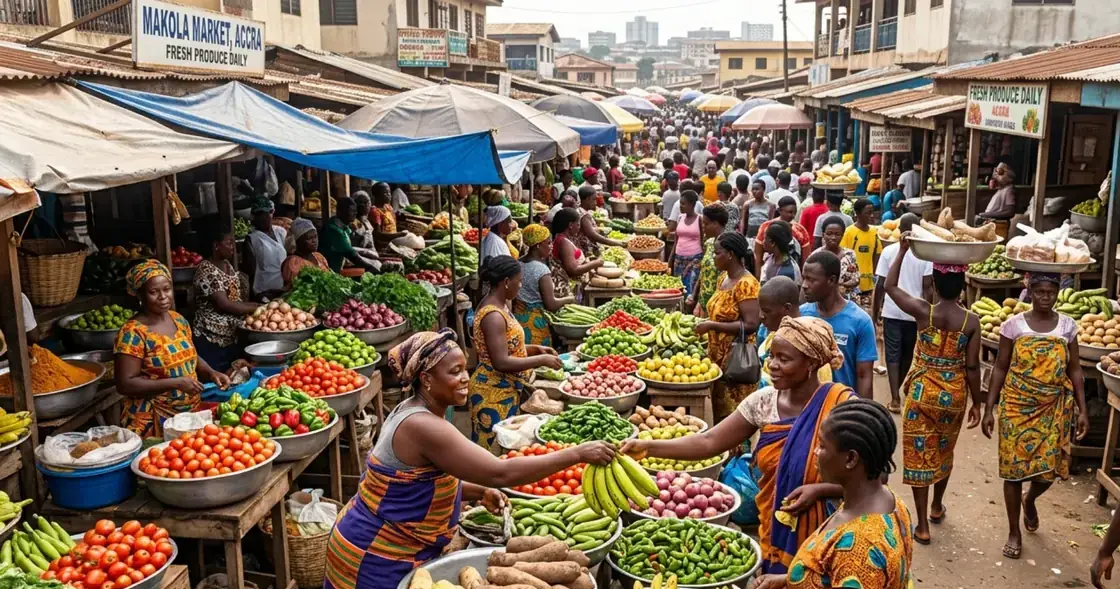
Ghana’s inflation decline is easing pressure on household costs as food and transport prices stabilise after months of volatility. The latest official figures show inflation slowing for a third consecutive period, driven by improved supply conditions and tighter monetary policy. The shift matters because rising prices have been a central burden for households and small businesses across the country. Authorities say sustained policy measures are helping to restore stability. The central bank has maintained high interest rates to curb inflation and support the national currency.
What is driving the slowdown in inflation?
Food prices, which account for a large share of household spending, have begun to stabilise following improved harvest flows and reduced supply disruptions. Transport costs have also steadied after earlier increases linked to fuel price fluctuations. “The current trend reflects coordinated policy action and improving macroeconomic conditions,” said Dr Ernest Addison, Governor of the Bank of Ghana. He noted that while inflation is easing, risks remain.
Government officials have linked the improvement to fiscal consolidation efforts. Finance Minister Ken Ofori-Atta said that the recent reforms aim to stabilise the economy and rebuild investor confidence. For many households, the change is beginning to translate into more predictable spending. Traders report fewer sudden price increases, allowing families to better plan weekly purchases.
Businesses warn recovery is still fragile
Despite the improvement, businesses say cost pressures remain high. Import-dependent sectors continue to face elevated expenses due to exchange rate fluctuations and global price trends. “We are seeing some stability, but operating costs are still high,” said Abena Mensah, a retail trader in Accra. “Customers are still buying less than before.”
Economists caution that inflation remains above long-term targets and could rise again if external conditions worsen. Professor Godfred Bokpin of the University of Ghana said structural issues continue to pose risks. “The decline is encouraging, but it is not yet secure,” he said. “Sustained discipline and external stability are critical to maintaining the trend.”
What it means for households
For ordinary Ghanaians, the slowdown offers limited relief rather than a return to affordability. Inflation falling means prices are rising more slowly; it does not mean prices are falling. Many households are still paying far more for food, transport, rent, school supplies and utilities than they did before the recent cost-of-living surge. The pressure is especially acute for low- and middle-income families, who heavily weight their budgets towards essentials. When food prices remain high, even slower inflation can squeeze savings, healthcare, education, or emergency spending.
Small traders and informal workers are also exposed. If households cut non-essential purchases, market vendors, shopkeepers, transport operators and service providers face weaker demand. That can reduce daily income in sectors where workers have little financial cushion. The improvement therefore needs to be interpreted carefully. A declining inflation rate is a positive macroeconomic signal, but it is not the same as household recovery. Real relief will depend on whether wages, farm incomes and small-business earnings begin to catch up with the higher price level.
The main risk is that the recovery remains uneven. Urban consumers may benefit first from steadier transport and imported goods prices, while rural households could continue to face high costs linked to fertiliser, fuel and local supply constraints.
The outlook will depend on continued fiscal discipline, exchange rate stability and global energy prices. If the cedi weakens or fuel prices rise again, the gains could quickly reverse. For now, the inflation decline signals progress, but the social test is whether families can buy more, save more and plan with greater certainty. Until that happens, the easing trend should be treated as fragile rather than decisive.
Sources: Ghana Statistical Service · Bank of Ghana · Ministry of Finance
Additional reporting and analysis by Nukunya News Desk.
Related posts:
 Ghana cedi stability improves amid foreign inflow gains
  Ghana’s inflation slows for third consecutive month as food prices ease
  MTN Ghana to Start Charging Customers for MoMo-to-Bank Transfers From June 1
  IMF PCI to Strengthen Bank of Ghana’s Balance Sheet
  Ghana Nears First Non-Interest Banking Licence as BoG Warns on Fintech Trust